
Natural Wine is Growing Up
From glou-glou to goth, from punk rebellion to glossy backlash, natural wine has completed its cultural arc. The next phase might require structure—in the glass and in the mind.
Thirst Behavior is a project about wine, taste, and the social performances that form around them, the rituals of enjoyment shaped by status, media, money, and desire. Wine is the entry point; the real subject is how taste gets made, circulated, and contested, especially in New York and the Hamptons, where leisure and tastemaking overlap most visibly.
You can find my most recent feature here.
Friday features are always free, but if you want the weekly intel and ongoing education—plus to support independent wine writing that doesn’t do scores or sponsors—upgrade whenever it feels right.
If you’d like to work together or have consulting inquiries, pitches, or scoops, please email me at bodhilanda@gmail.com.
On a recent trip to New Orleans, I ran into Jake Laugle in the middle of a hyper-specific pre–Mardi Gras ritual: Hannah Hayes’s Ham Parade. This is a small affair, a “parade” in the loosest sense of the word—really more of a stroll around the block in the Bywater for about twenty people. A friend of ours—also in the wine business, dressed fully in drag—was parading a leg of Benton’s cured ham down a residential block on a tricycle festooned with crocheted fruit and metallic fringe, while a small brass band trailed behind, playing familiar songs rewritten to include lyrics about ham. I mention this event as context because, how could I not? Jake and I fell into step behind the trike.
I’ve known him for years as an earnest evangelist of natural wine. By the time I tried to recruit him to join the wine program at Saint Germain, he had already accepted the sommelier role at Melissa Martin’s Mosquito Supper Club, where he has since become a defining voice in the city’s natural wine scene. Between Mosquito and his nonprofit pop-up series, Delicious and Harmless, Jake has built a real reputation—part educator, part tastemaker, part community organizer.
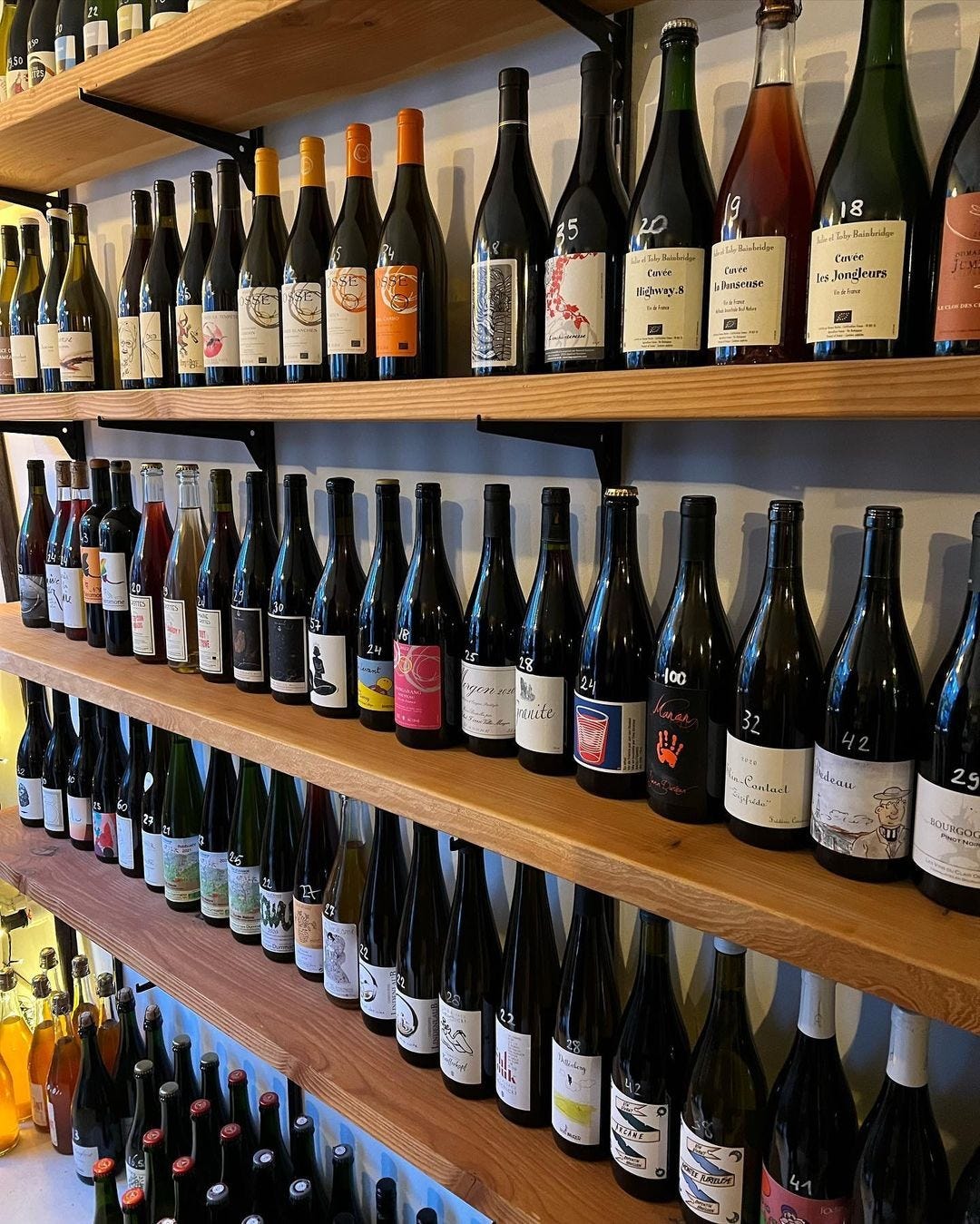
We were catching up when he mentioned that, in addition to Mosquito and the pop-up, he has been picking up shifts at Pluck, a wine bar in the CBD that doesn’t get nearly the credit it deserves. Pluck is not ironic about wine. It is not anti-canon. It is a place for grown-up drinkers with real curiosity. You can find serious classics—wines that require context and patience—alongside something like a Matthiasson pét-nat co-fermented with peaches. The bottles are presented without theatrics but with intention, and staff education is central to what they do.
Jake told me he’d started working there because he wanted more experience with traditional benchmarks—wines he didn’t have access to in his other roles. He wanted to round out his palate. Build references. Strengthen the technical scaffolding. The band struck up another ham-themed refrain: “I wanna hold your haaaam.”
It felt like a small sentence that contained an entire era.
For the last decade, it has been completely possible—totally legitimate, even admirable—to build an entire career in wine while largely riding the natural wave. You could become a respected buyer, a respected sommelier, a respected tastemaker, a person with real authority, without ever needing to spend much time on the old world scaffolding that used to be treated as the price of admission. I’m thinking of Amanda Smeltz, who gave the wine program at Roberta’s its character in the early days; Jorge Riera, who made his name at Contra and Wildair before establishing programs at Frenchette and Le Veau d’Or; and even Pascaline Lepeltier, who has ascended to Master Sommelier but still works mostly with natural wines. You did not need to be fluent in the canon in order to develop a point of view. In some corners, fluency in the canon was treated as actively suspicious, like you were showing up to a hardcore show in a blazer.
Natural wine made the wine world less stiff. It introduced drinkers to the idea that “good” could mean something other than expensive, pedigreed, and validated by a single, centralized critical apparatus. It re-centered farming, labor, and ethics, sometimes in a way that bordered on sanctimony, but still forced the broader industry to reckon with how little most consumers know about what goes into a bottle. It made “taste” feel less like a test you had to pass and more like a conversation you could join. It brought artists and cooks and young hospitality people into wine, as a language they could speak in public.
It also, inevitably, became its own kind of snobbery.
To claim that natural wine democratized access to wine and also reified a new language of snobbery is complicated, and even as I write those words, I worry that I sound like one of two deeply annoying people: either the bitter traditionalist who thinks natural wine is a scam invented by Brooklyn and evidence of civilizational decline, or the newly enlightened former natural wine fan who has decided to pivot into Respectability and now wants to lecture you about sulphur politics.
In truth, I contain elements of both people. But beyond that, I’m interested in how the discourse appears to be growing up, even as those two annoying archetypes still crowd the comments section.
Natural wine began, in its popular mythology, as anti-snob wine. In the classic telling, it was punk, it was acid house, it was a rebellion against points, against the legacy critic class, against the idea that good taste should be delivered from on high by a handful of gatekeepers with European accents. It was wine for people who were tired of being told they were drinking incorrectly. It was wine that promised to be alive, uncorrected, unfiltered, more like an expression than a product.
Then, as multiple writers have pointed out over the years, “natural” became something else: a symbol of virtuous consumption. If a certain era of wine snobbery was built around the performance of knowledge—regions, producers, vintages, classifications—natural wine offered a different performance: ethics, intimacy, proximity to the producer, proximity to the farm, proximity to authenticity. It replaced old-world hierarchy with a new kind of moral-aesthetic hierarchy.
The natural wine drinker did not need to know the difference between Puligny and Chassagne to feel superior. They simply needed to know that their wine was “clean,” “alive,” “raw,” “farm-driven,” “without bullshit,” and that someone else’s wine was “industrial,” “manipulated,” “dead.” This is a well-worn discursive move that we’ve all made at some point, often with the best intentions and the worst tone.
The discourse got funnier and meaner as it proliferated.
Orange wine, for a time, became the symbolic front line of this culture war, a category onto which both evangelists and skeptics projected their anxieties. In The New Yorker, Troy Patterson described it as a “delicious assault on pleasure,” capturing the peculiar dynamic whereby endurance becomes evidence of discernment. The tannin, the volatility, the haze—these were no longer merely sensory attributes but markers of seriousness. To appreciate orange wine was to prove oneself willing to withstand difficulty in the name of authenticity. What began as a rejection of snobbery risked becoming a different form of gatekeeping: if you did not enjoy it, perhaps you simply did not belong.
If Patterson’s essay approached orange wine with amused skepticism from within the culture, Byron Houdayer’s recent broadside in Vanity Fair, “The Case Against Orange Wine,” adopts a more theatrical posture. Houdayer casts the category as cultish and self-serious, beloved by urban aesthetes who mistake volatility for virtue, and treats its aesthetic codes as ripe for puncturing. The piece is less a technical critique than a social one; orange wine becomes shorthand for a certain kind of taste performance, and that performance is the real target. That such a takedown now feels legible in a glossy magazine is not incidental. It suggests that natural wine, once insurgent, has matured into something stable enough to satirize without explanation.
The mainstream press began to notice the same thing that restaurant people notice first: once something becomes a marker of cool, it attracts people who want to be seen being cool. At a certain point, you start watching “natural wine” move through the world the way certain sneakers move through the world. It becomes legible at a distance. You can recognize it on a table before you see the label. You can recognize it in the shape of the bottle, the typography, the import sticker, and in the slightly knowing way someone says “natty.”
At some point, even natural wine people started complaining about natural wine people (which, I realize, is what I’m currently doing).
We got the “natty fratty” discourse, which is really a story about dilution and translation: what happens when a subculture becomes a commodity, when the wine that signaled rebellion becomes a uniform, and when an aesthetic migrates into a broader lifestyle marketplace so that you can be a finance bro drinking Meinklang and still feel as though you are participating in something anti-establishment.
This is not unique to wine. This is what happens to everything with an identity attached to it. The thing that begins as a refusal becomes a template; the template becomes an industry; the industry becomes a job ladder; the job ladder becomes a résumé line; the movement becomes a vibe. The aesthetics of resistance are always eventually absorbed by the culture industry; with wine, the absorption happens quickly, perhaps because taste itself is so pliable.
The early shorthand had been glou-glou: chillable reds, crunchy gamay, bottles that felt like juice boxes for adults with strong opinions about farming. Bright labels. Light tannin. A sense that wine could be playful without being unserious. It was a mood as much as a category. And then something shifted. The bottles got darker. The labels got weirder. The pours got moodier. Wines once celebrated for their easy charm began to look, to certain corners of the scene, almost naïve. If everyone could do glou-glou, then glou-glou was no longer a signal. The insiders needed a new edge.
This is what PUNCH memorably called natural wine’s “goth phase.” The turn toward austerity, toward stranger ferments and more severe expressions, toward wines that felt less like a backyard hang and more like a dimly lit record store where the clerk judges you silently while flipping a twelve-inch.
The goth phase was about differentiation. It was the moment a subculture, having gone mainstream, had to reassert its seriousness. It was natural wine chic turning inward, away from its own accessibility, in search of a new frontier of taste.
This brings me back to Jake working at Pluck. When you build your education primarily inside the natural wine universe, you are building it inside a world with fewer constants. That is both the beauty and the limitation.
Classical wine is full of guardrails, for better and worse. Appellation laws. Varietal rules. Aging requirements. Traditions that are sometimes restrictive and sometimes genuinely clarifying. A Bordeaux is a Bordeaux because a dense historical and regulatory apparatus insists that it behave a certain way. A Barolo is in conversation with Barolo as an idea and a historical tradition. Champagne isn’t just an appellation and a style; it is an entire legal structure designed to produce continuity.
Natural wine, especially in its more unregulated expressions—Vin de France bottlings, experimental Loire micro-cuvées, unfiltered one-offs—has fewer of those guardrails. The wine can shift drastically year to year. The same producer can release wildly different expressions under the same label. The variables are not hidden; they are foregrounded. The wine is an event. Sometimes it is a good event, and sometimes it is a confusing event, and sometimes it is an event you politely lie about because the producer seems earnest and you do not want to be the person who says the wine tastes like a hamster cage.
When everything is allowed, you gain freedom, but you lose a shared reference system. You lose the friction that produces calibration. You can only go so deep, intellectually, if every bottle is a new set of rules. You can become extraordinarily fluent in the scene—its importers, its producers, its gestures, its arguments—without becoming equally fluent in evaluation beyond the scene’s own moral-aesthetic, even spiritual, language.
And that makes the matter of quality increasingly difficult to assess.
Of course, “quality” is a loaded term here. It has been used as a weapon by gatekeepers who confuse pedigree with merit and price with truth. But “quality” is also what you are trying to discern when you are deciding whether a wine is expressive or merely messy, whether it is unusual because it is intentional or unusual because it is unstable, and whether a fault is a feature or simply a fault.
If your only tools for judgment are “I like this” and “the producer is doing the right things,” then you are operating with a limited vocabulary. That vocabulary may be culturally powerful, but it is not always technically satisfying. It is also, frankly, not always helpful in service, where guests are not trying to join your politics club. They are trying to drink something that tastes good with their food and that does not have the aftertaste of corn chips or pennies.
A while back I wrote a piece called “It’s OK to Hate Natural Wine,” which a lot of people seemed to like, though many of them seemed to take it the wrong way. It was, in fact, a defense of the enjoyment of natural wine, aimed at someone who understands the slipperiness of vibe creation in a different aesthetic practice.
It is okay to hate natural wine, because some natural wine is flawed, and because the scene has sometimes insisted that you pretend flaws are virtues in order to maintain your membership card. It is also okay to love natural wine, because a lot of it is beautiful, and because the movement created space for genuinely thrilling expressions that would not have survived under older regimes of correction and standardization.
The problem is not the wines. The problem is when the term “natural wine” becomes a totalizing identity, a badge that collapses a wide range of practices and outcomes into a single moral category and then asks you to perform allegiance rather than judgment.
Jake isn’t abandoning natural wine. He is seeking new benchmarks. He is seeking a vocabulary that does not require him to treat every bottle like a sacred exception. He is acknowledging, in a pragmatic way, that the classics are not just museum pieces but useful texts.
In my own career, I did something like the inverse. I started in a world where “classic” was treated as the default, and then I moved deeper into natural wine when I built the program at Saint Germain. That shift was liberating. It expanded my sense of what wine could be, what service could be, and what a list could communicate. It created a space where I could be a bit more myself, rather than a gatekeeper of aristocratic dining culture, as I had been in New York. It also taught me, over time, that rebellion is not a stable foundation for an education. Eventually you need something more than refusal. Eventually you need integration.
This is where I think we are headed, whether we admit it or not: the term “natural wine” is going to be abandoned. It has outlived its usefulness. It did the work it needed to do as a rallying cry, and now it is mostly a blunt instrument that produces unnecessary heat and very dumb arguments. That is okay.
Whatever we call it next—maybe “living wine,” as Noble Rot’s Dan Keeling has suggested—will hopefully carry more nuance. It is not that we stop caring about farming, labor, additives, or integrity. The next phase is that we talk about those things with precision, and only when they are relevant.
We talk about sulfur levels when they matter to what is in the glass. We talk about filtration when it affects stability. We talk about farming practices because they shape flavor and because they shape the lives of the people doing the work. We talk about a producer’s politics if those politics are central to the story we are telling, not as a blanket excuse for mediocrity and not as a purity test for the drinker. We stop using “natural” as a vibe synonym and start using actual language again.
This is, in a way, the most flattering outcome for the movement. If natural wine becomes normal wine—if its best ideas get absorbed into broader practice and its worst habits get mocked into retirement—then it has succeeded. It has changed the culture.
The goth phase will pass. The glou-glou era will be remembered fondly and then periodically revived like a band reunion tour. The finance bros will move on to something else once it stops signaling anything. The haters will keep hating, which is their sacred calling. But the serious people—the ones actually trying to learn, to taste, to serve, to build lists that mean something—will keep doing what Jake is doing: expanding their references, deepening their vocabulary, and pushing the discourse to evolve past the terms that once felt indispensable.
And if you have ever made “natural wine” your whole personality, you can relax. You are allowed to mature. You are allowed to drink a good bottle of Rioja without acting like you are betraying your friends. You are allowed to admit that a wine is faulty, and you are allowed to like it anyway. You are allowed to want benchmarks. You are allowed to want structure—structure in the glass, in the form of tannin and acid that hold a wine upright, and structure in your education, in the form of references that hold your judgment steady. You are even allowed to be curious about the classics.
The most anti-snob move is not refusing the canon, but knowing it well enough to refuse it selectively, with taste.