
Enter the Somm-Operator
The best wine lists in New York now feel personal precisely because the financial arrangements behind them have become more elaborate — and harder to copy.
Thirst Behavior is a project about wine, taste, and the social performances that form around them, the rituals of enjoyment shaped by status, media, money, and desire. Wine is the entry point; the real subject is how taste gets made, circulated, and contested, especially in New York and the Hamptons, where leisure and tastemaking overlap most visibly.
You can find my most recent feature here.
Friday features are always free, but if you want the weekly intel and ongoing education—plus to support independent wine writing that doesn’t do scores or sponsors—upgrade whenever it feels right.
If you’d like to work together or have consulting inquiries, pitches, or scoops, please email me at bodhilanda@gmail.com.
It is, improbably, a great time to drink wine in New York City. Lists are getting weirder and more personal, finding increasingly inventive ways to offer value at nearly every price point. Last week, I found a bottle of 2014 Coffinet-Duvernay Chassagne-Montrachet Blanchots Dessus for $255 at Oriana. This is obviously not the average person’s idea of an affordable experience, but for mature white Burgundy from a respected grower, in a room full of marble-topped tables and unmistakably expensive contemporary art, it was a proposition I was more than happy to entertain.
Oriana opened a couple months ago in a newly renovated Nolita building, the latest effort from Andy Quinn and Cedric Nicaise, the team behind the Noortwyck. The place speaks the fluent, largely placeless language of contempo-luxury. It is a kind of dining room increasingly prevalent in New York, although it could exist just as comfortably in Denver, Seattle, Austin, or anywhere else VC and tech money finds its way into the hospitality trade. The wine list is different: specific, eccentric, unmistakably the work of a person with his own ideas about what belongs on a world-class list and what those things should cost.
This is one of the more sophisticated sensations a restaurant can produce. The bottle was expensive; I knew roughly what it would cost elsewhere; there was nothing remotely democratic about the room in which I drank it. Still, the price felt not merely defensible but generous, as though the restaurant and I had arrived independently at the same peculiar conclusion about what the wine was worth. That feeling of alignment is increasingly available on the best wine lists in New York, where the old arithmetic of restaurant wine is being replaced by something more personal, elastic, and difficult to reproduce. I enjoyed my first glass with some embered oysters from the restaurant’s custom hearth oven, laden with bubbling ’nduja and neatly arranged in a bowl of hot rocks. How, I wondered, did this wine get here?
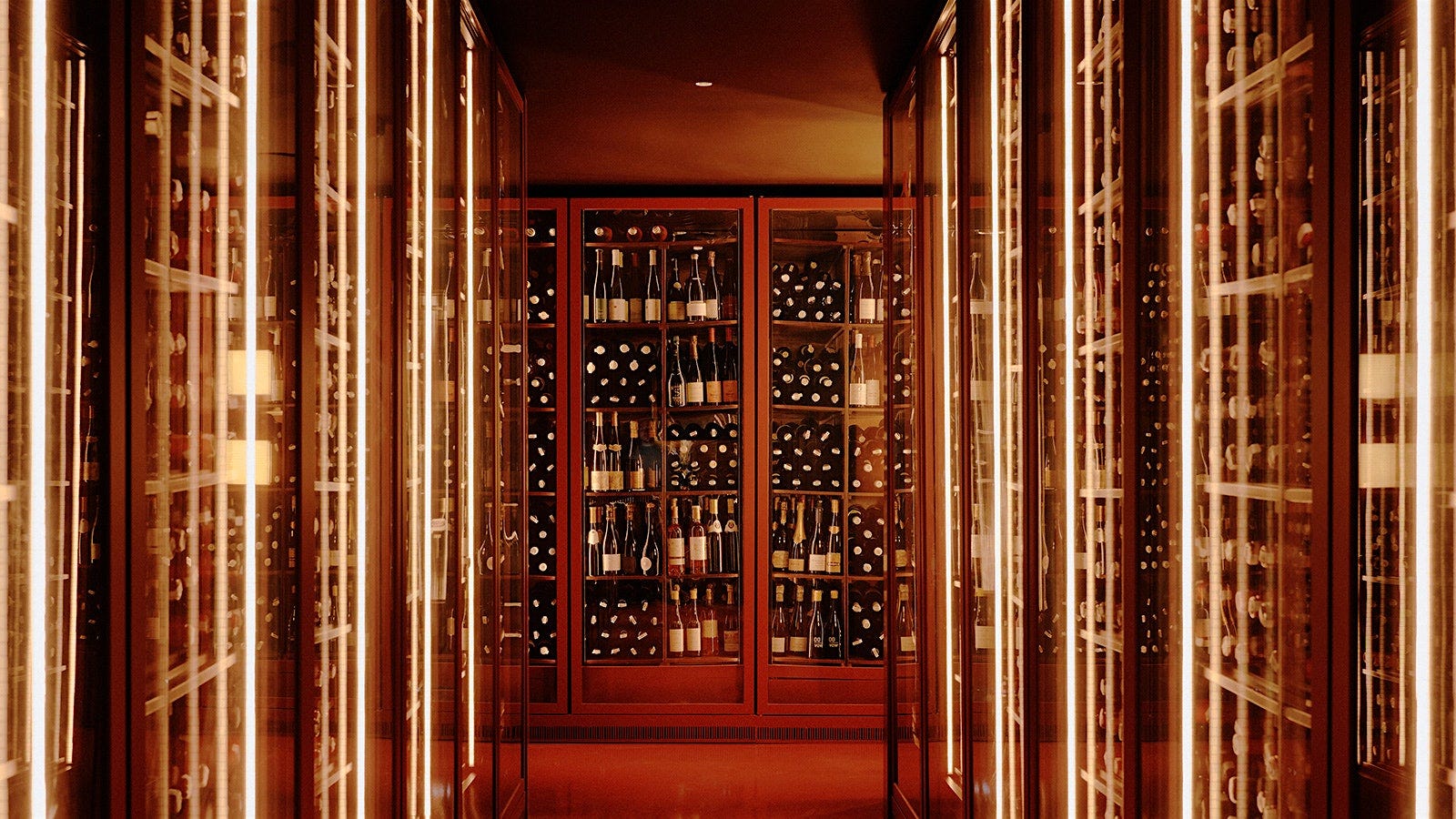
The first bottle Cedric Nicaise bought for Oriana was in March of 2024. The restaurant opened in May of 2026. If you have spent any time around restaurant openings, you know how strange this is. I recently submitted the opening order for a small bar in the West Village; its entire wine inventory, admittedly only around forty cases, arrived one week before the soft opening. This is the normal sequence. You look at the distributor books, place the orders, open the restaurant, and begin discovering all the things you should have done differently.
You do not generally spend two years accumulating wine for a restaurant that does not yet exist. Cedric could because Oriana’s investor, the tech entrepreneur Kevin Ryan, understood the cellar as an asset rather than a pile of inventory waiting to spoil the cash flow. Ryan had also purchased a Nolita building that had been empty since the late nineties and was willing to wait through a lengthy revitalization effort. The cellar and the restaurant were both allowed to develop at the speed of real estate rather than hospitality, which is to say with considerably more patience and considerably more capital.
While interviewing Cedric, I referred to him almost accidentally as a “somm-operator.” The phrase slipped out on my way to asking a question about gaining an investor’s trust, but he stopped to consider it.
“There aren’t that many sommelier-operators,” he said. “It’s kind of a new category, and I think we’re writing it as we go.”
The term is useful because it describes something more consequential than a sommelier who has managed to open a restaurant. A wine director usually operates within a hierarchy of competing intelligences: the somm knows the wine, the chef knows the food, the general manager knows the room, and somewhere above or adjacent to all three is a person who knows that the beverage cost has moved two points in the wrong direction. Taste may be respected within this arrangement, even lavishly accommodated, but it remains a department.
The somm-operator turns taste into executive power. “When I was at EMP, I answered to an accountant,” Cedric told me. “My accountant is now paid by me.”
This does not mean the accountant has been banished, or that the numbers have stopped mattering. It means the person who understands why one bottle should cost $88 and another can withstand a much more aggressive markup is now in a position to impose that judgment on the mathematics. At Oriana, Cedric prices every bottle individually, looking for the lowest number a guest will feel good about paying that still makes the restaurant money (although what constitutes “making the restaurant money” when the principal owner is also the landlord, and the restaurant functions partly as an amenity for the VC office tenants upstairs, is somewhat unclear). Sometimes the markup is two times cost; sometimes it is five. “Percentages don’t go to the bank,” he said.
A fixed markup treats consistency as a kind of fairness: every bottle bears the same multiplication, nobody receives special treatment, and the spreadsheet remains innocent. But guests do not experience wine prices as percentages. They experience them as a field of numbers carrying information about what kind of place they have entered, how much fluency is expected of them, and whether the restaurant has decided to be on their side. Pricing is part of the hospitality before anyone has tasted anything.
Chase Sinzer has constructed the lists at Claud, Penny, and Stars around this kind of emotional, numerical reading. At Stars, eighty-eight bottles priced at $88 or less appear at the front of the list, establishing affordability as one of the restaurant’s organizing principles. Once you believe a restaurant has made a serious effort to offer value, the trophy bottles somehow look more attractive.
The somm-operator can extend that authorship further down the supply chain. A conventional wine director buys mostly from distributors, supplemented by allocations, consignments, and perhaps the occasional auction purchase, because restaurants generally prefer their inventory to arrive by the case, with an invoice, from somebody already entered into the accounting software. Cedric’s purchasing philosophy is more expansive: “Anyone who’s willing to sell a bottle of wine, I’m willing to entertain it as a purchase.”
The Oriana cellar draws from distributors, auction houses, online retailers, private collectors, and winemakers Cedric visits in Burgundy. Because he travels there to see friends, he does not feel obliged to amortize the cost of the flight across the bottles he brings back. The cellar is not a survey of what happened to be available during opening month. It is a record of two years spent watching, traveling, bidding, asking around, and buying wine from places that do not send tidy weekly offer sheets.
Chase’s three restaurants create a different kind of freedom. A bottle that makes no sense at Claud may be perfectly at home at Stars; wine purchased as part of an allocation can move through the portfolio until it finds the list, price, and audience that suit it. A single restaurant might have to decline an interesting bottle attached to six less interesting ones. With three rooms and three distinct concepts, he has substantially more power to secure allocations of in-demand bottles and buy at a volume that enable his friendly markups.
“There’s nothing I hate more than an Excel spreadsheet wine list,” Chase once told me. There is, certainly, no shortage of spreadsheets behind his restaurants. What he hates is the point at which accounting becomes visible as an aesthetic: each category dutifully populated, every markup flattened into consistency, the particular replaced by the operationally convenient. Three distinct restaurants give him enough places to put the wine that no individual list has to resemble one.
All of this sounds, and to some degree is, like a triumph of expertise. For years, restaurant sommeliers were expected to possess exhaustive knowledge while remaining institutionally subordinate, held responsible for the financial performance of programs whose most important conditions they did not control. The somm-operator can choose the acquisition channel, move margin around the list, buy across several restaurants, and cultivate a cellar over years rather than ordering whatever Burgundy remains available in the final months before opening. The person with taste now signs the checks.
The difficulty is that the checks still have to clear.
The conditions that make these lists possible are highly particular and not remotely portable. Nobody can hand an ambitious wine director the template for acquiring a patient tech investor, a vacant Nolita building, and permission to begin buying Burgundy two years before opening. The purchasing power of three successful restaurants becomes available only after somebody has opened three successful restaurants. Even the supposedly asset-light solution of consignment depends on years of relationships with collectors who own the right bottles and trust you enough to place them in your cellar.
The best lists in New York currently feel more personal because the financial arrangements behind them have become more elaborate. More kinds of money have been assembled so that one person’s judgment can become unusually legible: the investor’s money, the collector’s cellar, the allocation earned across several restaurants, the bottle discovered at auction, the real estate allowed to remain vacant until the room is ready. Capital, time, property, inventory, and fifteen years of cultivated relationships do not appear on the list, but they determine what can appear there and at what price.
This may not be a model for the future of restaurant wine so much as a luxury available to a very particular class of restaurant. It is nevertheless producing remarkable lists. Cedric spent two years deciding what belonged in Oriana’s cellar, where he was willing to make his margin, and what a mature bottle of Chassagne-Montrachet ought to cost when it finally reached the table. The spreadsheet has not disappeared. It has been subordinated to a sommelier’s peculiar theory of value.
great read, as always.