
Thirst Behavior is a project about wine, taste, and the social performances that form around them, the rituals of enjoyment shaped by status, media, money, and desire. Wine is the entry point; the real subject is how taste gets made, circulated, and contested, especially in New York and the Hamptons, where leisure and tastemaking overlap most visibly.
You can find my most recent feature here.
Friday features are always free, but if you want the weekly intel and ongoing education—plus to support independent wine writing that doesn’t do scores or sponsors—upgrade whenever it feels right.
If you’d like to work together or have consulting inquiries, pitches, or scoops, please email me at bodhilanda@gmail.com.
A few weeks ago, I spent forty-seven dollars on a glass of wine and left feeling as though I’d gotten an incredible value.
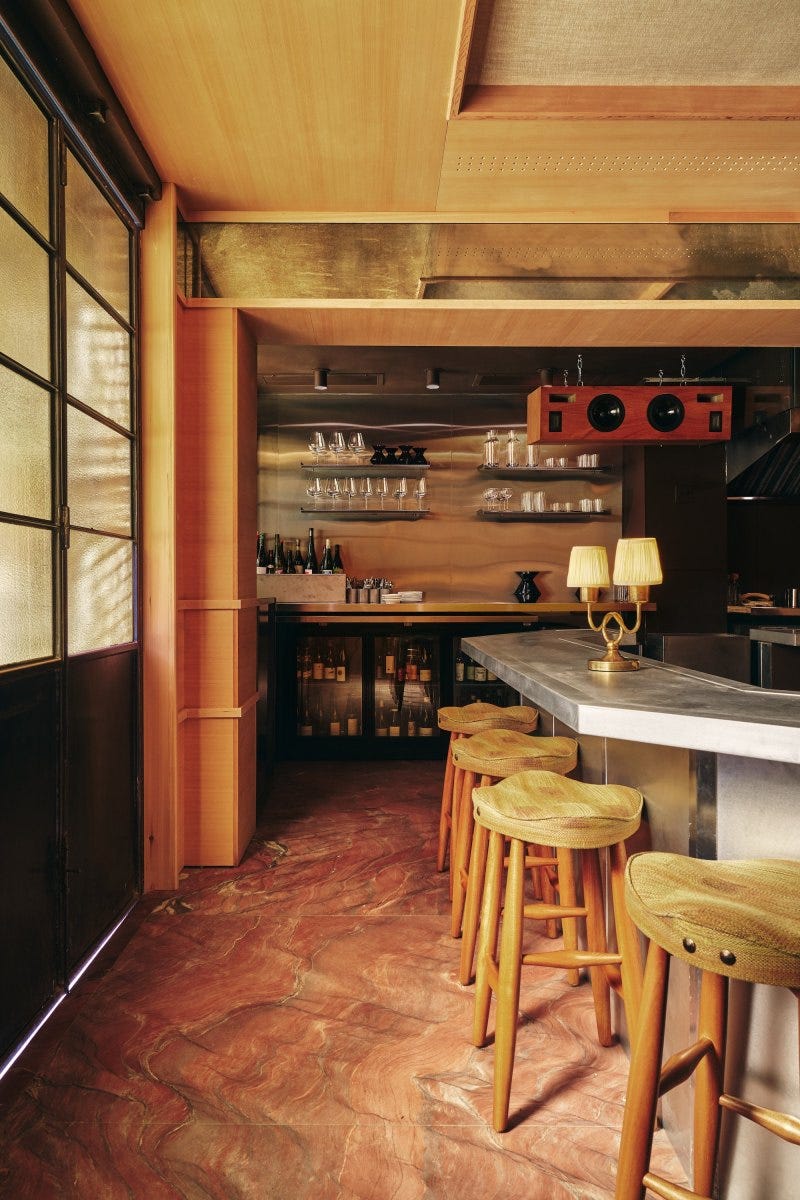
This was at Stars, the now beloved third act from Chase Sinzer and the team behind Penny and Claud in the East Village. I opened the heavy, metal door to a hypnotic fanfare of dulcimer that I recognized as Four Tet’s Two Thousand and Seventeen. Though I arrived within the first hour of service, I was nervous there would be a wait. Turns out, there was one seat left, right at the end of the horseshoe-shaped zinc top bar that serves as this tiny room’s focal point.
Everything in this room is intentional. Nothing seems oversized. Nothing feels squeezed in. There is very little in the room, and everything that is there appears to have earned its place. A Tom Bloxam-designed custom speaker hangs dead-center, acoustically calibrated for the 450-square-foot space, its frequency range running from 38 hertz to 25 kilohertz (roughly the full spectrum of what the human ear can interpret). The mahogany finish matches the legs of the bar stools. I’m told it can play insanely loud but they keep it at the perfect volume, favoring clarity and focus over low end power. You can hear the music perfectly, and converse at a normal level. A rail runs along the back wall at the perfect height for standing and leaning, effectively doubling the bar’s capacity without crowding anyone.
The glass of wine in question was Benjamin Leroux Auxey-Duresses, handwritten on the single page by-the-glass menu. Leroux is one of Burgundy’s most respected négociant producers with an impressive lineup of wines that spans from Bourgogne Aligoté all the way through the Grand Cru Bâtard-Montrachet. Auxey-Duresses is a village in the Côte de Beaune without a single Grand Cru vineyard, which means it can’t command the price point that a more famous neighboring vineyards can. Betting on it over Puligny or Meursault is a sommelier’s move: you care more about the style of the person who made it, than the prestige of the appellation, because you know the fruit is almost the same.
Before I’d ever set foot in this place I wrote about it for Caper, as part of a piece about price architecture, and what happens when you take smaller markups and prioritize hospitality. The part most people already know is that this list has eighty-eight selections under eighty-eight dollars, which in Manhattan is a radical statement on its own. The first three pages have something for everyone at a friendly price. The brief sparkling section shows definite range: from a half-bottle of A. Berger Champagne, to a Loire pét-nat rosé from La Grange Tiphaine, to something called Grape Republic from Yamagata, Japan. Whites range from a forty-eight-dollar Txakoli to an Alsatian Riesling from Domaine des Marnes Blanches’s second label, Coup de Jus, to Enfield Chardonnay from California. There is a section for orange wines, another for rosé and coferments. The reds pull from the contemporary natural wine movement, showing names like Hervé Villemade and Rocher des Violettes alongside Ardèche producers I’d never heard of, plus some more familiar picks like a Priorat and a Sangiovese from Emilia-Romagna.
Once you’ve been seated in a comfortable bar stool, offered water and salty marcona almonds, and taken a look at their tremendously reasonable by-the-glass program, only then do you get to see the depth of the cellar. It is a wine list ogglers dream, with in-demand names like Bachelet, Antoine Lienhardt, Ramonet and Roulot. Pages that reveal accumulated obsession, seemingly all with vertical depth and real quantity. Prices get about as high as they do anywhere else, but you can kind of see why. These wines are not available to everyone. You acquire them by having relationships, by spending years building allocation channels, by knowing consigners, by being the kind of operation that producers trust with their tiny production.
Stars wants to serve the person drinking a glass of Jura pét-nat, and the person wondering whether anyone in New York still has mature Raveneau in stock. It wants to be democratic without being simplistic and serious without becoming exclusionary. Wine culture has spent decades treating accessibility and expertise as opposing values. Stars does not seem particularly interested in that argument. It built a list where both things are true, and the list pursues these parallel statements with high levels of swag.
For a room containing a genuinely absurd amount of wine knowledge, the atmosphere was surprisingly free of the annoyances that usually accompany it. Nobody was lecturing or showing off. There were clearly industry people in the room (I recognized Eddie Huang’s voice across the bar before I saw him), but there were also people who had wandered in off the street. A family next to me, parents and a grown son, were asking one of the sommeliers, a young woman, how she knew so much about wine. Gracefully, she told them she did a program called WSET, which provides foundational education, and that she simply enjoys drinking wine and does it a lot.
The food menu is small, in selection, in portion, and in price point. I was overjoyed to learn you could get their much-talked-about deviled eggs by the individual piece. A vadouvan-like curry spiced yolk is piped into the egg whites and topped with puffed chicken skin in the shape of a star. Two bites and a sip of white Burgundy later, it was gone, and nothing about the moment felt like it needed anything else.
The peppadew peppers arrived stuffed with spicy chorizo and candy-sweet, tasting uncannily like a pepperoni pizza. Salty, super tangy, just spicy enough to bully the Burgundy a little. I paused and ordered a glass of Seehof ‘Elektrisch’ Feinherb Riesling for fifteen dollars. It provided a bit of sweetness to moderate the spice and acidity of the peppers, and I could return to the Leroux when my palate had regained its equilibrium.
Later in the evening Chase stopped by the bar. I asked him how he managed to open a place with so much confidence — a beautiful, doubtless expensive build-out, a massive inventory of high-end wine, and extremely affordable options in every category. The math of all this didn’t exactly make sense to me. His answer was something along the lines of: the staff is good, the room is small, we turn seats, and we make sure people are happy.
His answer tracked. All three people on the floor that night were serious sommeliers and the lone person in the kitchen a serious chef. The room was beautiful and the sound system bespoke, the music thoughtfully chosen and the light amber and forgiving. The wine list was affordable and deep, the snacks perfect and available in exactly the quantity you wanted. Everything that actually matters in hospitality was there, and not much else.
By the end of the evening I had spent around ninety dollars. Objectively, ninety dollars for a solo visit is not inexpensive. And yet, it felt like one best values I’ve encountered all year. The forty-seven-dollar glass of Leroux Auxey-Duresses was, by the way, delicious, but when I walked out, it wasn’t what I was thinking about. What stuck was the reductionist impulse at the core of the place: the wine was not cheap and the room was not inexpensive to operate, but every element seemed aligned toward the same goal. Everything reinforced everything else. Nothing was ornamental but everything was beautiful. Everythin
And there is also the fact that you could ignore all this intention, grab a seat at the bar, order a seven-dollar Miller High Life, make it a Spaghett for another three bucks, and catch up with an old friend.
You get to decide.