

The best restaurants make you feel like you’re getting away with something.
The lighting is forgiving, candlelight softening edges as it glints off glassware, your water refilled before you realize it’s low. Someone appears at your elbow exactly when you need them and disappears exactly when you don’t, and for an hour or two you’re suspended in a small, carefully arranged fantasy—front and back of house moving in concert so you can pretend that none of this took any effort at all. You didn’t cook, you won’t clean, and nothing is asked of you except appetite; desire is anticipated, and whatever mess preceded your arrival has already been cleared away.
That ease—the feeling that everything has already been taken care of, that you have been expertly cared for—depends on a system that only works as long as some of the people doing the work remain invisible.
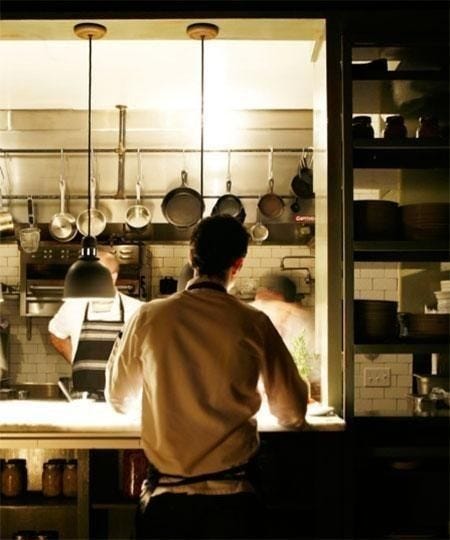
What we are seeing now is what happens when an industry built on invisibility is forced—suddenly and publicly—to confront the collision between its aesthetic ideals and its labor realities.
Over the past several weeks, Immigration and Customs Enforcement has conducted what it calls Operation Metro Surge—a coordinated campaign of raids, checkpoints, and arrests targeting undocumented immigrants in major American cities. The effects have rippled through industries that depend on immigrant labor, but nowhere more visibly than in restaurants.
In Minneapolis, the response has shown what hospitality looks like when it stops pretending to be neutral.
Modern Times Cafe—a neighborhood institution near Powderhorn Park—switched to a donation-based model, refusing to charge customers and therefore refusing to collect sales tax. Owner Dylan Alverson, who witnessed federal agents shoot and kill both Renee Good and Alex Pretti—American citizens who died trying to protect others—and was tear-gassed alongside his neighbors, renamed his restaurant “Post Modern Times” and announced it would offer free food to anyone except ICE agents “until the occupation of Minneapolis is over.” Staff agreed to work as volunteers, paid through shared tips and community donations.
The message was explicit: we will not generate revenue for a government that publicly executes civilians in broad daylight.
Other restaurants closed their doors entirely—some because employees were too terrified to leave their homes, others as an act of solidarity. At Manny’s Tortas in Midtown Global Market, four of ten employees stopped showing up. The owner now delivers supplies to former workers sheltering in place. El Rodeo, Brasa St. Paul, and The Donut Connection went dark. One restaurant drew its blinds, locked its doors, and posted a volunteer at the entrance to screen who could enter.
What’s happening there is happening everywhere. The difference is that Minneapolis has been forced to show us what the industry looks like when business as usual is no longer an option—when restaurants have to decide, in real time, whether hospitality is merely a service or something closer to a civic obligation.
What it’s choosing to reckon with is this: the American restaurant industry doesn’t just rely on undocumented labor. It depends on the idea that this labor can remain indefinitely informal, indefinitely out of frame.
After nearly two decades working in New York restaurants—long enough to see every role from the inside—I can say this with certainty: most of the people who shaped my understanding of hospitality are immigrants, many of them undocumented.
They are the best cooks I know. The most reliable prep workers. The ones who show up early, stay late, work overnight. Who remember exactly how you set up your station. Who cover your shift when you’re hungover. They model a level of consistency and professionalism that the industry depends on.
But there’s another thing about New York restaurants and immigrant labor that’s mentioned less often. It’s not only that the work is brutal, or that immigrant workers are underpaid and undervalued—though both are true. It’s the incomparable level of skill.
In New York, restaurants don’t just use immigrant labor. They fully depend on it. The pasta you waited two months to have the privilege of eating, the risotto that tastes exactly like it did last time, the perfect sauce presented exactly as it looks in the magazine—those don’t make it to your plate because the chef with their name on the door is back there every night. It’s because the line cooks and prep cooks are that good.
This is practiced, embodied knowledge, built through repetition and time—through years on the same stations, under the same pressure. When we celebrate New York’s restaurant culture—when we post the plates, chase the reservations, publish the lists, hand out the stars—we are celebrating that work, even if we rarely acknowledge where it comes from.
The undocumented workers I know understand the system. They have no illusions about the industry loving them back. The terms of the deal are well understood: work hard, stay invisible, hope nothing breaks. The work is exploitative at times, and it is never truly safe. But within those constraints, skill can translate into something like mobility. Being very good at the work matters. Experience accumulates. Reputations travel. People move up, move on, send money home, build lives in one of the world’s most expensive cities.
We’ve seen effective and genuinely inspiring responses from the industry in Minneapolis, and other cities should take notice. Even before Minneapolis, some of the fiercest defenses of undocumented immigrants I’ve encountered have come from restaurant owners. I’ve also seen absolute indifference. Of the people and places I’ve worked for, I don’t think you’d be able to guess who falls into which category.
At this moment, what we owe each other isn’t a single prescription, but clarity—about what kind of industry restaurants already are, and what it means to participate in them, whether you’re cooking, serving, or eating.
When you’re in a restaurant, sometimes you can see through the dining room into the kitchen. There’s a line—the station where tickets hang and plates come up and cooks move in a rhythm they’ve practiced a thousand times. This is the line where the food we eat is transformed from the product of labor to a vessel of aesthetic significance. The people working that line are the reason you get to eat. Some of them were born here. Some of them weren’t. Some of them are hidden. Some of them are trying to stay that way.
That’s the other line. The one between what we acknowledge and what we pretend not to see.
It goes further. Pan out to where that food that is invisibly prepared so well comes from. From the fields to the slaughterhouses immigrants are the ones bringing those raw ingredients to the restaurant. The entire food system depends on their labor.