
John Rutter’s carol “What Sweeter Music” has been stuck to the inside of my skull for years. I first encountered it in my freshman year of high school singing in the Palmer High Chamber Singers. And, while I generally despise Christmas music, this modern choral banger still makes it into yearly rotation, usually alongside a roast chicken with anchovy butter, or a Chartreuse-spiked hot chocolate. As an adult, this is a Christmas ritual that I continue to engage in without irony.
Rutter sets Robert Herrick’s 1647 lyric—“What sweeter music can we bring / than a carol for to sing…”—as a slow unfolding: harmony blooming like light through stained glass, sweetness arriving not as candy but as clarity, as if the choir were tuning the room to the perfect moral frequency. Herrick’s text (a courtly Christmas poem that long predates the Victorian sugarplums we now associate with the genre) is explicitly about sweetness as devotional nearness, a sensory figure for being close to the divine.
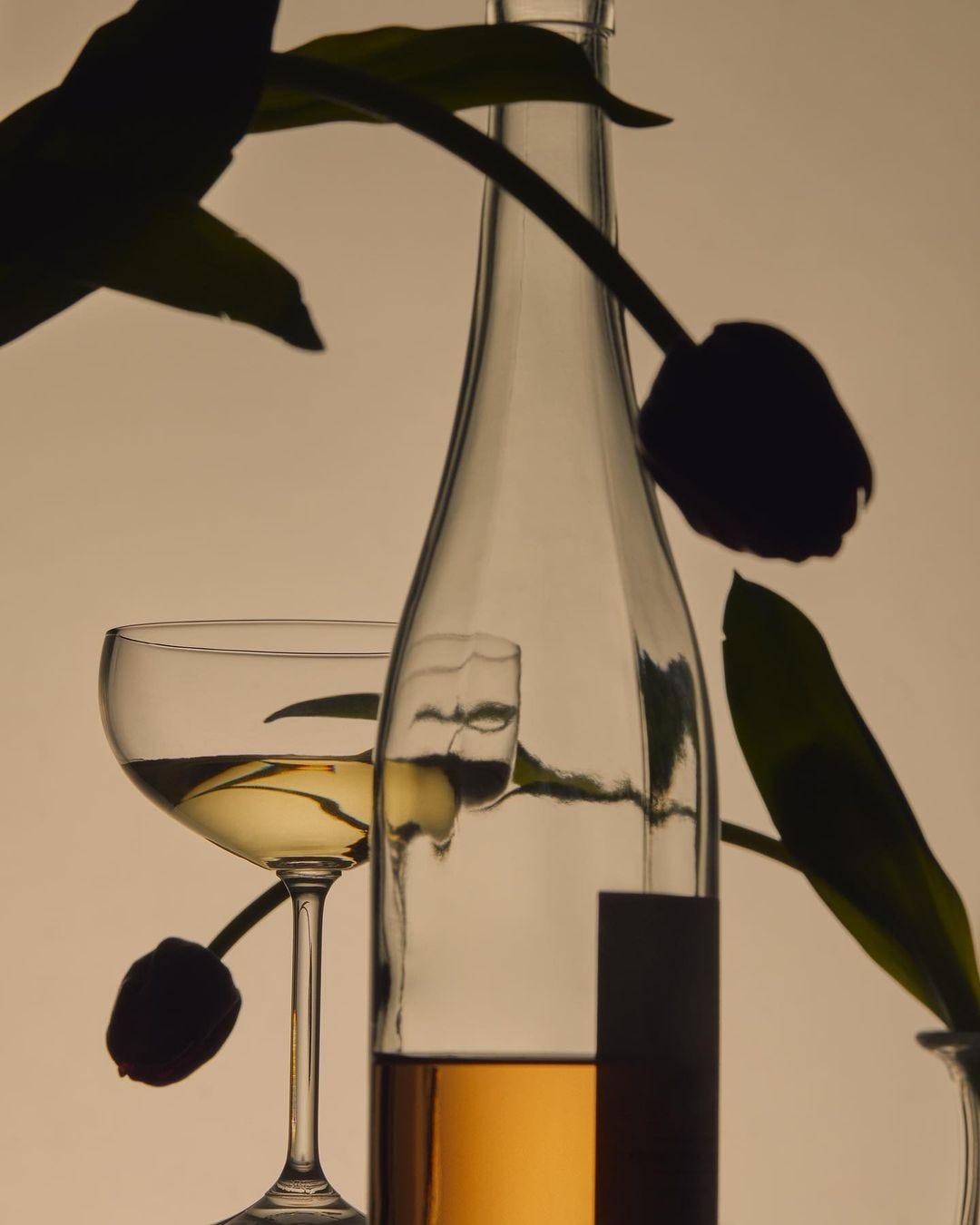
Sacred language returns to sweetness over and over; “Taste and see that the Lord is good” is the psalmist’s invitation, a line that metabolizes theology into sensation. It’s hard to be more embodied than that — taste as proof, flavor as faith. In English hymnody, the sweet name of Jesus “sounds” and “soothes” (John Newton making the ineffable legible in the mouth and ear). And beyond metaphor, there is the sacrament itself: the Communion cup, historically filled with wine that was often sweet, taken into the mouth as both remembrance and real presence. Here, sweetness isn’t symbolic shorthand for something else — it is the Divine, enacted. The sugar, the wine, the blood, the God: all met in a sip. In this light, sweetness is something holy, the straightest line to ecstasy, the most literal contact point between body and mystery.
This is why I find the dining-room performance of “anything dry, please” to be such a weird rite. If you work the floor long enough, you start to recognize the stock lines: a guest sits down, glances at the list, and says, “Anything dry,” or, “I’d like a glass of red, but nothing too sweet.” That “too” always makes me smile—its subjectivity is obvious, yet it’s delivered as if there’s a universal threshold we all agree on. No one ever says “too acidic” or “too tannic” with the same gravitas, and of course no one would knowingly serve something that’s “too” anything! Sweetness is the only structural element people feel compelled to disclaim in advance.
The joke, of course, is that most modern table wines are dry—meaning ≤4 grams per liter of residual sugar, sometimes up to ~9 g/L if the acidity is high enough to hide it. In practical terms, you could line up a dozen such wines with slightly different sugar levels and many casual drinkers wouldn’t be able to tell which is which. But the request isn’t about chemistry—it’s about optics, about affect. “Make it dry” is a reflex, a little shibboleth deployed at the moment of ordering to ward off embarrassment. It’s a preemptive strike against the imagined judgment of the server or sommelier, a way to signal, I may not know what I’m talking about, but I know enough to avoid the one thing I’ve been told will mark me as unsophisticated. You could call it a tic, but it’s also a kind of table-side password, a talisman, a nervous flourish in the choreography of ordering. In a dining room where the air feels charged with rules you might break without knowing, “make it dry” is the conversational equivalent of adjusting your posture—small, automatic, and meant to show you belong. But I think it’s time to let it go. This knee-jerk, defensive and arbitrary posture against sweetness severely narrows the range of what people will allow themselves to publicly enjoy. The fact is, some of the most complex, food-friendly and highly classified wines in the world are, indeed, a little sweet.
Take Riesling, for example: in its highest forms it isn’t syrupy or cloying but meticulously balanced, with acidity sharp enough to keep the sugar on a tight leash. A Kabinett from the Mosel might have 30 or 40 grams per liter of residual sugar — an amount that would be sickly in a flabby wine — but paired with searing acidity, it lands like a squeeze of lemon on ripe stone fruit. I’m thinking of something like Willi Schaefer’s Graacher Himmelreich Kabinett: delicate white flowers on the nose, a palate that swirls between green apple and lime zest, and just enough sweetness to keep the edges from cutting. The finish isn’t sticky; it’s mouthwatering. That tension is the point. In high-acid whites (Riesling, Chenin Blanc) and certain sparklers, a little sweetness is architecture, not decoration. It’s there to make the wine whole. It’s there to ground aromatics to the palate and really make them felt. To write off the entire category because you’ve been told “sweet” means “cheap” is like refusing to eat ripe peaches because you once had a bad can of fruit cocktail.
My question is why — in a culture that baptizes fries in ketchup, that praises the nootropic properties of Diet Coke, and that worships at the altar of the Negroni — is dryness treated as a kind of moral purity of taste? It’s as if choosing a wine without perceptible sugar says something not just about your palate’s flavor thresholds, but about your character: disciplined, restrained, above easy pleasures. The insistence on dryness is a performance of virtue through abstention — what Terry Theise has described as the “prevailing, (and I’d say pathological) aversion to sweetness.” That pathology isn’t trivial; it’s a form of cultural absolutism that, I believe, carries all kinds of deeper biases.
I was reminded recently of this moral dimension of the sweetness paradigm by Bronwen Wyatt’s essay The Making of Myths About Sugar. She traces how “sugar is poison” became a cultural reflex, built on pseudoscience and recycled by diet culture and the influencer economy. Yes, overconsumption can cause health problems. Yes, sugar lights up reward pathways. But the blanket moralization — the leap from “too much is harmful” to “all sweetness is suspect” — is one of those cultural scripts that makes us feel virtuous for avoiding pleasure itself. As Wyatt writes, this framing implies that “we value the denial of pleasure above all else. That our health is entirely in our hands. And if we are not well, then we have only ourselves — and our imperfect desire for sweetness — to blame.”
I found the essay compelling, though I still have my ambivalence. I’m far from qualified to get into the weeds about women’s diet culture, so from here on out, I’ll draw a distinction the between the act of eating sugar and the act of tasting sweetness — the aesthetic, fleeting sensation that operates differently from the diet and nutrition conversation. But this is the point I want to hold onto: sweetness, as an affective phenomenon, carries a charge. Furthermore, to reclaim it is not just to embrace a certain kind of pleasure, but to stage a small act of aesthetic antagonism against the codes of official taste.
In 2009, I was working at Thirst Wine Merchants in Fort Greene, which is one of those rare New York neighborhoods with a Black, multi-generational upper-middle-class. One afternoon, a young woman walked in while I was in the shop alone. She wore a vintage tee and had the bars of the Black Flag logo tattooed on her inner forearm. She asked, almost amused, “Do you have any sweet wines?” I balked. This was such an adept performance of taste that it kind of broke my brain. I didn’t judge her interest in sweet wines, but I did wonder if she was provoking me to. Without knowing whether I was being actively trolled or not, I showed her what we had: a Kabinett from J.J. Prüm — slate and green apple, classically Mosel — and a couple of Peter Lauer’s stony Saar bottlings. If memory serves, she left with Von Winning.
It’s that same sense of provocation, of ambiguous antagonism, I think about when sweet wine shows up in rap lyrics. In the late 2000s and early 2010s, there were lots of them: Kanye West “beasting off the Riesling” in Run This Town; Jay-Z snarling “piss Bordeaux and Burgundies, flush out a Riesling” on Tom Ford. Then there’s the whole subgenre of Moscato-rap: Waka Flocka Flame sipping it in No Hands; Drake sliding it into a lobster-and-shrimp tableau; Future dragging the syllables of Moscato into a whole atmosphere on Detail’s track of the same name.
Kanye’s “beasting off the Riesling” doesn’t picture a candlelit pour in a white-tablecloth setting — it’s chaotic, sweaty, almost feral, Riesling as the catalyst for a night that’s already half out of control. He flips the grape’s reputation for delicacy into a symbol of his own lit-ness. Jay-Z, meanwhile, is more calculated. Tom Ford is a diss track aimed at the cheap, goofy maximalism, and Tumblr-wave aesthetics of Trinidad James and his SoundCloud-era peers. “I don’t pop molly, I rock Tom Ford” lays down the aesthetic hierarchy: rock over pop, authenticity over trend, legacy over flash. Then comes the wine flex. “Piss Bordeaux and Burgundies” is a boast of excess, but to “flush out a Riesling” lands like a sly inversion — a grape coded as “sweet” made the lingering after-effect of all that expensive consumption.
Sweet wines in rap work as both canon and heresy — borrowed from the Michelin cellar, flipped until they register as party fuel, sex metaphor, or interior design choice. In white-tablecloth culture, sweetness is what you disclaim to prove you belong; in these verses, it’s what you flaunt to prove you don’t need permission. Riesling, Moscato, Bordeaux, Burgundy — all the consecrated grapes and regions are fair game. But, when a sweet-coded wine takes center stage, it comes with a wink: the very note fine-dining orthodoxy codes as juvenile or vulgar becomes the flex, the punchline, inverted symbol of status.
That’s the charge that sweetness carries: little acts of antagonism, reminders that the canon isn’t fixed and “Dry” was never natural law (think back to the hymns!). When sweetness is claimed the signal flips — what’s supposed to read as naïve suddenly lands as luxury, as control, as cool.
Certainly, not all sweet wines are cool. There are many that are very bad and worthy of invective. But you know what’s less cool, even than those? Writing off all sweet wines because you don’t know how to enjoy them, or worse, you won’t let yourself. I’ve done my best here to deprogram you from the moral imperative of dryness. So now, let’s talk about how to enjoy those visceral, mischievous, heretical, and delicious off-dry selections.
Start with heat: a Mosel Kabinett alongside Thai papaya salad or Sichuan hot pot. The sugar doesn’t fight the spice, it absorbs the blow — a cooling hand on the shoulder while the acidity keeps the dish sharp and alive. The wine doesn’t smother the heat; it lets you play longer in the fire. Or go the other way, into decadence: pour Sauternes with foie gras, the golden liquid lacquered over the rich, fatty liver like sunlight on velvet. The sugar cuts the fat while also leaning into it, a duet of excess that feels almost illicit.
Even the half-forgotten classics come back to life in the right frame: demi-sec Champagne with fried chicken, bubbles scrubbing the palate between bites of salty, greasy crunch, the hint of sweetness making the whole thing sing. Or off-dry Vouvray with Indian curries, where honeyed Chenin fruit folds into the spices until you’re not sure whether the sweetness is in the wine or the food or both. But the point is that they match. These are but a few mesmerizing expressions of detail and balance that can only be achieved when the wine carries sweetness.
Suspicion of sweetness has never really been about sugar. It’s about access — about who gets to enjoy what, and on whose terms. That’s why dryness gets coded as virtue in the dining room, while sweetness gets coded as vulgar, unserious, or juvenile. But the codes themselves are flimsy. Sweetness is just as capable of carrying seriousness and style. In fact, that’s the point: it doesn’t just stand in for pleasure, it delivers it. The sugar, the wine, the song, the body — all collapsing into one immediate fact. So the next time you feel the reflex to say “just something dry,” try the opposite.
Ask for sweetness. Let it be the thing itself: immediate, embodied, undeniable.
If you’ve ever found yourself reflexively asking for “something dry,” I’d be curious to hear what might convince you otherwise. What wines, meals, or moments have shifted your sense of sweetness — toward pleasure, toward provocation, or toward something stranger? Hit reply, leave a comment, or pass this along to someone who still needs convincing. The conversation is always better when more people’s palates are in the mix.