
The Trade
the invisible labor of taste, and the unlikely workers who keep wine culture interesting
When I started working as a sommelier, no one back home in Texas really knew what that was, much less how to pronounce it. It seemed like a job worlds apart from the community I grew up in—something vaguely European, snobby, and definitely not for us. If people did know what it was, it was only enough to mock it. A sommelier was the guy in the bowtie who swirled a glass and said stuff like “unctuous mouthfeel.”
I often laugh to myself when guests ask, “Where did you discover your passion for wine?” I did not have a passion for wine. I got into wine because a manager told me that if I learned enough about it, I could get a raise. That was the entire pitch. I was twenty-two, broke, and ambitious enough to take the deal. Wine wasn’t a calling; it was an opportunity for professional advancement. And for a kid from a working-class, single-parent home, I knew I had no choice but to take it.
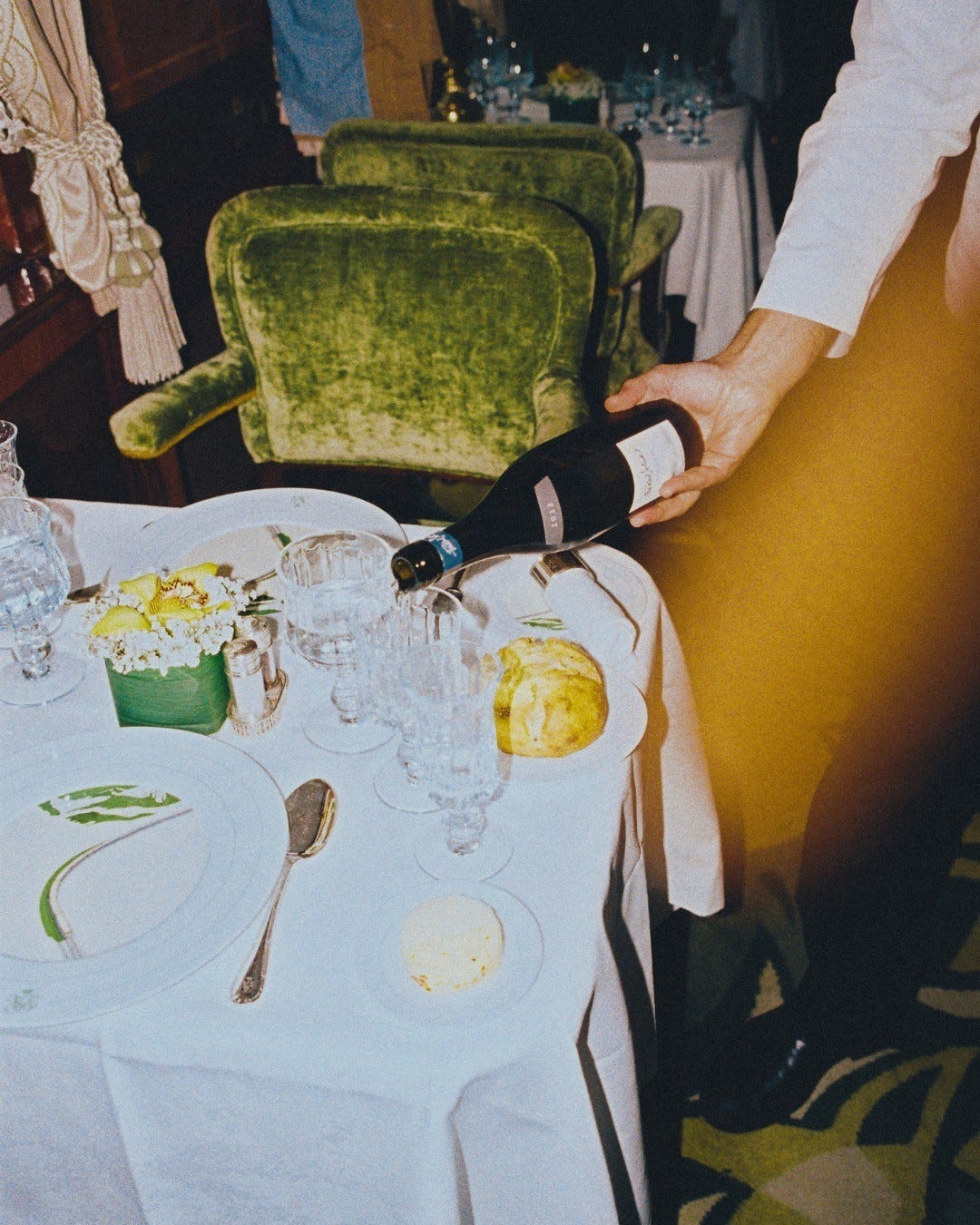
The Waverly Inn, where I was working, paid for my first certification course and the exam that followed. It felt like I was being offered a gift—and also a long-term contract. In 2012, young wine people were hard to come by, and it was highly advantageous for a restaurant to train from within. Because I’d studied art history, the memorization, the vocabulary, and the aesthetic evaluation came naturally. Having grown up speaking Spanish and studied French in college, the pronunciations didn’t scare me either. I could describe a glass of Volnay the way I’d once described a nude by Girodet: form, texture, tension, balance, tonality.
Though I hadn’t escaped hourly work, something had shifted. I was doing, at least partly, knowledge work—the kind that lives in language, gesture, and the illusion of refinement. What looked like taste was actually labor. I was memorizing appellations the way a carpenter might memorize joinery or a sailor might learn knots.
The Culture of Work, the Work of Culture
I often write about taste as culture—how the language of wine encodes class, how drinking habits reveal ideology. But this time I want to write about wine as work—labor disguised as cultural fluency. Because understanding the culture you’re part of is a job in itself. It’s unpaid, unacknowledged, but essential to moving up.
Wine knowledge in restaurants isn’t usually a matter of passion; it’s leverage. It’s one of the few currencies in hospitality that reliably converts to upward mobility. Learn enough about soil types and growing regions, and suddenly you’re not polishing glassware anymore—you’re leading service, running pre-shift, helping to train your colleagues. It’s not about becoming a connoisseur. It’s about becoming legible to power.
I’d never worn a suit before my first day on the floor as a somm at the Waverly Inn. I’d saved to buy a bespoke suit from Sebastian Grey shortly after it launched its New York showroom, but my mom ultimately footed the bill as a wine school graduation gift. After a few months working the floor in a suit, I was a natural candidate when a manager position freed up—partly because I already looked the part. That’s just how it works.
My education, my language skills, even my ease with aesthetic judgment—all of it conspired to make me seem competent long before I truly was. It’s absurd, in hindsight, to think that someone who’d never heard of Puligny-Montrachet a year earlier was now being trusted with bottles worth more than his weekly rent. But that’s how quickly proximity to taste can become a substitute for experience.
Meanwhile, I was scrambling to catch up to my credentials. I tried desperately to understand whatever David Kamp or Glenn O’Brien were talking about in that month’s Vanity Fair, or why Thom Browne’s suits looked like they were made for overgrown schoolchildren, or why, in the middle of a historic recession, everyone who came into the restaurant seemed to have infinite money.
I was also walking through the produce section at the Union Square Whole Foods trying to train my nose: could I smell the difference between a navel orange, a cara cara, a tangerine, a satsuma? What about between a Granny Smith and a Golden Delicious? Ripe pear versus underripe pear? Cardamom, clove, cinnamon, nutmeg, star anise, the whole gamut of baking spices—did I actually know what those things smelled like, or did I just recognize the words from tasting notes?
Still, I was aware that I was a natural fit for this system in a way others weren’t.
Who Gets to Study Wine
The official paths to advancement—WSET, the Court of Master Sommeliers, American Sommelier, the course I took—remain stubbornly out of reach for the people who would most benefit. The exams are expensive, the study materials full of structural biases, and, most of all, they demand time that many busy restaurant workers simply don’t have. They reward people who already know how to study, not those who are still learning how to survive.
I was lucky. My employer paid for my certification. I had the vocabulary of art criticism and the confidence of someone who already spoke the right languages—literally and socially. (Not to mention that I was willing and able to show up early and carry boxes up and down the stairs before my shift started.) But most restaurant workers will never get that kind of institutional validation. Their skill remains invisible, even as they use it every night.
Imagine if every restaurant treated wine education as a shared resource, not a management perk. Picture the glass polisher quietly memorizing the regions on a back label, the busser who asks to taste the leftover Barolo after service. Imagine giving them structure, mentorship, and access to the same world-class education executives write off on their corporate cards as a hobby.
I’ve seen what happens when access opens up. One of the kids I mentored had fled gang violence in Guatemala. When we met, he was polishing glassware six days a week, sending most of his paycheck home. He learned fast. Now he runs the beverage programs at Dirty French and the Ludlow Hotel. Then there’s the Dominican kid who worked his way up from backwaiter to sommelier at Carbone. A lifelong New York Mets fan, he applied the same brain that obsessively memorized baseball stats to Burgundy crus and Champagne growers.
If you’ve worked in New York restaurants, you know a hundred characters like these. They’re the ones who make the industry hum—its muscle, its memory, its rhythm—even if you don’t see them interviewed by influencers at wine fairs.
Mobility can happen anywhere—line cooks become sous chefs, runners become managers—but there’s something especially wild about seeing it in wine. Because wine is supposed to be the province of privilege. And yet, some of the most passionate, disciplined, and intuitive tasters I’ve ever met are people who grew up nowhere near a vineyard. They learned because they had to.
Education as Labor Activism
I recently came across Wine Empowered, a nonprofit offering comprehensive wine education, free of charge, to women and minorities. It was founded by three accomplished professionals, among them
, Beverage Director of Côte and Coqodaq, and author of the Restaurants, Wine, and People Substack. James has long been outspoken about the industry’s darker side—especially its treatment of young women—having chronicled her early years in wine with a candor that made a lot of powerful men uncomfortable.For decades, the professional wine world has been ruled by a peculiar breed of man—part drill sergeant, part football coach, part theater kid. The kind who confuses command with charisma, who treats service like a stage and education like an initiation rite. You can picture him: navy suit, tight smile, gesturing too broadly in the dining room, his confidence just a little too loud. These are the men who turned tasting into a full contact sport and mentorship into a contest of obedience. The Court of Master Sommeliers codified the type—its rituals half both monastic and militaristic—presided over by figures like Fred Dame, whose eventual fall from grace only confirmed what many already knew: that too often, the power these men wielded over the culture of wine had less to do with knowledge than with control.
What James and her collaborators are doing with Wine Empowered is a structural correction. They’re taking the most valuable resources in the business—knowledge and network—and putting them back in the hands of the people who actually make restaurants work. This is why I’ve come to think of accessible wine education as a form of labor activism. When the people who touch the product understand it as deeply as the people who sell it, hierarchy starts to lose its edge, and wine culture gets more interesting.
The New York restaurant industry has always run on imbalance: knowledge climbs the ladder while credit stays put. Affordable education shifts the balance. It makes understanding what you serve a condition of the job, not a privilege. The goal isn’t exactly to mint more sommeliers, but to distribute wine literacy more widely.
From Trade to Culture
What changed my life wasn’t a single wine, but the realization that the supposed markers of taste—vocabulary, confidence, cultural literacy—were just another form of work. Hard work. Work that anyone could do if they needed it badly enough.
No matter who you are, engaging with wine is a kind of performance of belonging. But the best performances come from the people who weren’t supposed to be onstage in the first place—the ones who learned the script while bussing tables, who carry the map of Burgundy in their heads the way others memorize subway lines. You can see it in how they move, how they pour, how they talk about a bottle without showing off. They didn’t arrive by lineage or leisure, but by necessity—and that necessity made them better. The unlikely ones are almost always the ones performing at the highest level, because they never forget what the work costs.
If you’ve been reading along this far, you already understand the spirit of what I’m building. The next phase of this project is Wine School—a digital course that takes the bones of a traditional sommelier certification and reimagines them for the culture we actually live in. It’s rigorous but simple, complete but conversational. My goal is to make high-quality wine education accessible to anyone who wants it, whether you’re in restaurants, in retail, or just someone who wants to feel fluent at the table. I want it to feel like a bridge, not a barrier. If you’ve ever wished a course like this existed—or know what would make one worth your time—hit reply and tell me what you’d want to see inside. This is the continuation of that same project: turning knowledge into access, and access into culture.