

There’s no meal more overdetermined than Thanksgiving. The menu feels spookily state-mandated: turkey, stuffing, cranberry something, beige starch. And yet the culture around it is so endlessly fussed over that I wonder if anything new can ever be said about the Thanksgiving table. Every publication rolls out its annual “How To Not Ruin the Turkey” manual; somewhere in the world, someone’s uncle is explaining brining ratios or his deep-fry-the-whole-bird method to someone else’s uncle; people are Googling “best Thanksgiving wine” at the last possible second and getting a total mess of AI summaries and newsletter-signup popups.
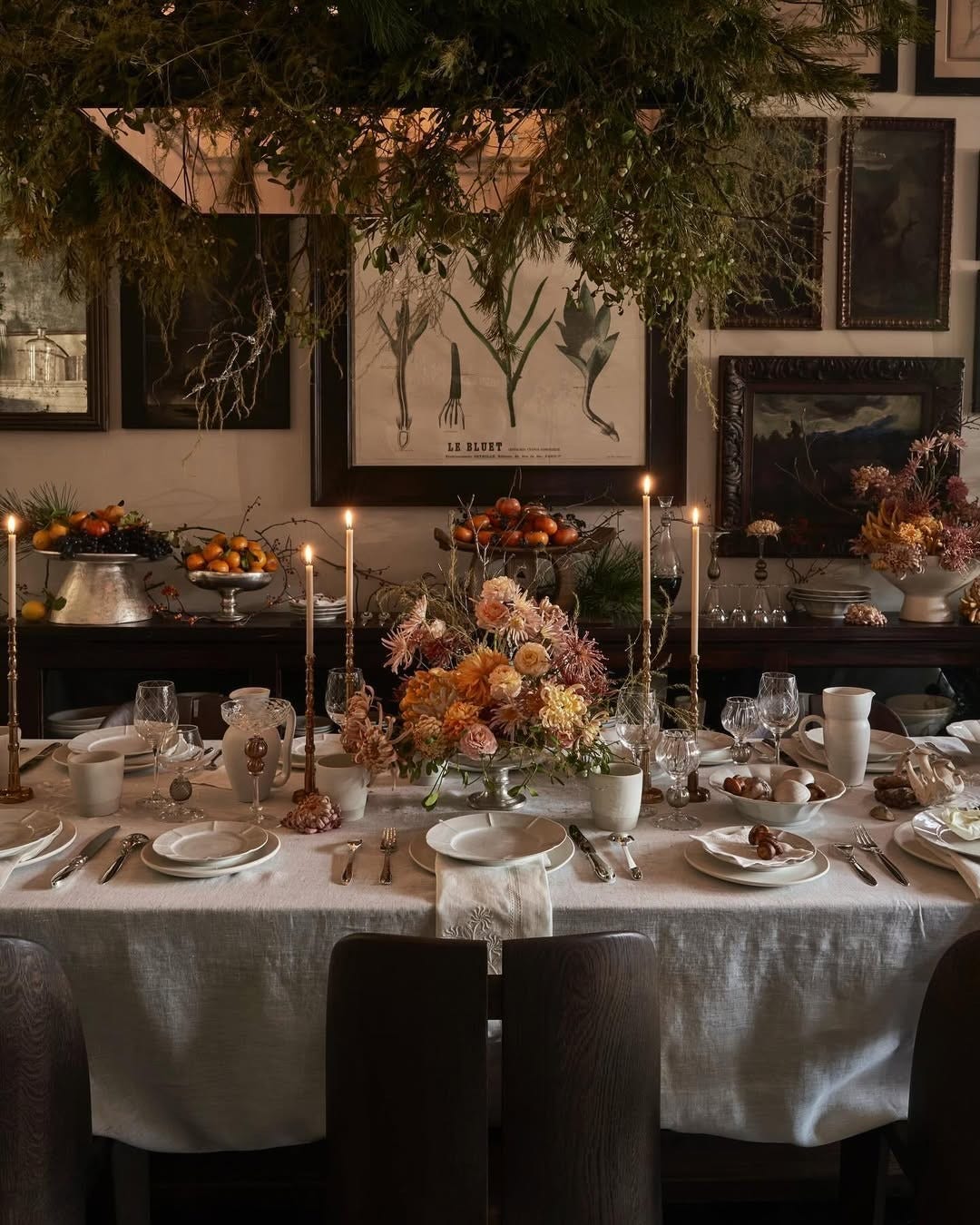
The food is not the point. Not really. For some people, Thanksgiving is just the annual family summit—an intergenerational potluck of personalities. For others, it’s a giant dinner party with friends, performed under the banner of tradition but powered by the same social electricity as any other night when you get people you love (or merely tolerate) around a crowded table.
Chelsea and I hosted Thanksgiving at our house in New Orleans for years, and they remain some of the most lit holiday dinners I’ve ever experienced. Our circle then was almost entirely industry people—servers, chefs, bakers, bartenders, distributor friends with bottomless backpacks of samples. People would trickle in during the early afternoon straight from the racetrack, where they’d been betting on races, playing the slots, drinking Bloody Marys, and wandering around in flamboyant outfits high on mushrooms. We did it open-house style: a long table, doors open, guest list fluid, people coming and going as they pleased. There was always enough to drink, and the food was always—if memory serves—interesting.
We were not Thanksgiving purists. Both of us are allergic to the American culinary idiom—roasted turkey, weird casseroles, the mandatory sweetness of savory things (never mind the flavors of colonial violence and historical revisionism). But we are extremely down to host a dope dinner party with lots of wine. So we used to freak the format a bit and let other culinary traditions in, keeping the core ingredients traditional. Here are some highlights from our Thanksgiving parties of the New Orleans era:
We both have an enduring passion for Mexican food, and Mexican year was absolute fire: turkey breast oven-roasted with crispy skin, dark meat folded into a rich, herby, peppery green pozole. The supporting cast of side dishes included roasted carrots with pepitas, avocado, and salsa macha, plus fresh-pressed masa tortillas with hoja santa leaves printed into them. All of that was great, and we had the triumph of being able to put out chips and guac for apero hour without having to apologize for being thematically out of step with the meal.
We also did some Chinese-ish experiments: the fried rice thing, where confit turkey, chestnuts, and broccoli got wok-sautéed with wild rice; a bok choy side with a “brown sauce” gravy and crispy garlic; handmade turkey dumplings; and a super slappy cold app of wood ear mushrooms dressed in toasted sesame. This is also where I discovered the incredible pairing that is Krug Grande Cuvée and eggrolls (more on that some other time).
For the Middle Eastern-leaning year, we brought back the shaved-raw-Brussels-sprout salad I used to make with Molly Baz in college: apple cider vinaigrette, candied pine nuts, and fresh pomegranate seeds for that fruity pop. I remember ending this night with my friend Breanne Kostyk (who now owns the world’s best bagel shop, Flour Moon, in New Orleans). She came after dinner with a bottle of 2009 Château Musar blanc, a blend of two native varieties from the Bekaa Valley, Lebanon. She somehow intuited that this is one of my forever wines, responsible for multiple epiphanies over the course of my life, some wine-related, some not. It’s really got it all: oxidative funk, slippery texture, intellectual density, spiritual heft. I could go on.
Another year, at a friend’s Anglo-pub-style Thanksgiving, we contributed roasted radishes over horseradish-scented whipped ricotta, a dish that turned some heads in both good and bad ways.
What I’m trying to say is that if you can cook, you can make Thanksgiving food that is actually good. And if you’re even mildly curious, letting other culinary idioms guide your treatment of the “traditional” ingredients is one of the great joys of the holiday.
So what about wine?
The real answer is: it doesn’t matter. Thanksgiving is never about nailing food and wine pairings. It’s about making sure you—and more importantly everyone else—are having a good time.
Yes, of course Burgundy is great: it has the cranberry top notes, the mushroom-forest funkiness, the whole roasted-bird symphony. Loire Cab Franc is a bit spicier and more piquant but no less correct. Well-aged Bordeaux goes with everything on the table and looks handsome doing it. Southern Rhône blends are built for rich, herbaceous, slightly chaotic plates. And if the food is lighter or your crowd is thirsty, young Beaujolais or Loire Gamay function beautifully as table wine in the original sense—bright, juicy, hydrating, unbossy.
This is also one of the few days of the year when richer Rhône whites—Châteauneuf blanc, Marsanne/Roussanne blends, even a rounded-out, fatty lil’ Viognier—really go off. Of course white Burgundy works (it rarely doesn’t); start with an Aligoté from Chablis to wake everyone up and save the Meursault or Puligny for when the table is humming.
Darker rosés deserve more respect at this time of year. They bring berry fruit, a cool temperature, and just enough tannin to keep pace with all the brown stuff at the table.
I, personally, try to mostly drink bubbles all day. Opening something special with your sweetheart at 2 p.m. while you prep is the best part of Thanksgiving. Your brain still works, you’re cooking (literally and spiritually), and the day hasn’t gotten weird yet. This is the moment for the really special bottles if you’ve got them: Egly-Ouriet, Doyard, Selosse (Jacques, obviously). Having a little glass of super classy Champagne while you prep for your loved ones is the best gratitude lesson you’ll have all day. It’ll also refresh the palate between tastes of your celery root velouté.
But once guests start arriving, I pivot to Champagnes that outperform their price point without demanding attention. Think Pierre Gimonnet, Gaston Chiquet, Lafalise-Froissart—the “why is this so good?” tier. They’re crisp, energetic, and correct with basically everything on the snack table. And if Champagne isn’t what you want to pour all afternoon, clean pét-nats, Alsatian crémants, and sparkling Rieslings all do the same job beautifully: acid, refreshment, energy, and enough lift to keep your palate awake through a very long, very beige meal.
Here are a few operational notes from someone who’s done some TG hosting:
1. Create a wine station — and satellites.
Your wine station should have a few easygoing bottles already open and as many wine keys as you can spare, all in plain sight. And critically, it should live outside the kitchen. Thanksgiving has a centrifugal force problem: people migrate to whatever room feels busiest. If the wine is in the kitchen, that room becomes Grand Central Station, and suddenly you’re trying to baste a turkey while twelve people perform small talk directly behind you. Putting the wine elsewhere—and placing satellite bottles around the house like decoys—pulls the center of gravity away from the stove. It keeps the cooks sane and the room moving.
2. Let guests participate.
When someone arrives with a bottle, walk them to the wine station, hand them a wine key, and encourage them to pop it open and pour a splash for whoever looks empty. It’s a simple sleight of hand: guests feel useful, they’re immediately folded into the social fabric, and—crucially—they’re no longer clogging the kitchen doorway asking if they can help.
It’s distraction, delegation, and hospitality all at once. The whole party becomes self-sustaining, which is exactly what you want on a day with this much emotional entropy.
3. Your glassware system should be user-friendly.
This doesn’t mean fancy. It means obvious. Glasses should be as grab-and-go as napkins. A crate, a tote, a bar cart, a cardboard box lined with a dish towel—anything works as long as people don’t have to interrupt you mid-sauté to ask where the stems are. Thanksgiving is a high-entropy holiday; eliminate as many friction points as you can.
4. Resist the urge to explain anything.
Every host knows this moment: someone pours themselves a glass of something and asks a casual question like “What’s this?” If you answer with more than one sentence, congratulations—you’ve started a wine seminar. Now you’re talking about semi-carbonic Valencian Bobal to a person who thought they were just being polite. Let the wine speak for itself. If someone wants a deep dive, they’ll stay after dinner and ask.
5. Have a digestif on hand.
One of the best Thanksgiving hosting moves I’ve ever seen was at a post-Covid outdoor edition of Thanksgiving. Someone showed up with Del Maguey Vida mezcal and Amaro Sfumato, mixed them 1:1, and started handing out tiny digestif shots toward the end of the meal. It was perfect—smoky, bitter, medicinal—the exact jolt people needed to stand up from the table and remember how their bodies worked.
Wine, at its best on Thanksgiving, is not the event—it’s the support. It keeps the day buoyant. It buys you space. It distributes the crowd. And nothing—absolutely nothing—should be too precious to open.
If the food is good and the company is interesting, the wine will find its place.
If the food is weird and the company is chaotic, the wine will save you.
Either way, you’re covered.