

A quick note for new subscribers: Welcome! This week, we’re in the middle of a special five-part mini series called Wine School, where I’m laying out the essential building blocks of wine knowledge: viticulture, winemaking, regions, varieties, and styles. It’s a crash course designed to get you up to speed quickly and easily. If you missed the kickoff, start here
Wine School posts are also a preview of a digital course I’m building. Founding Members get full access to the structured version as it rolls out, plus everything else I publish. Upgrade to the Founding Tier to get it all in one place.
Next week, we’ll return to regularly scheduled programming: essays on wine and the performance of taste, the politics and aesthetics of appreciation, affect and performativity, and what’s unfolding across New York’s hospitality scene. For now, class continues.
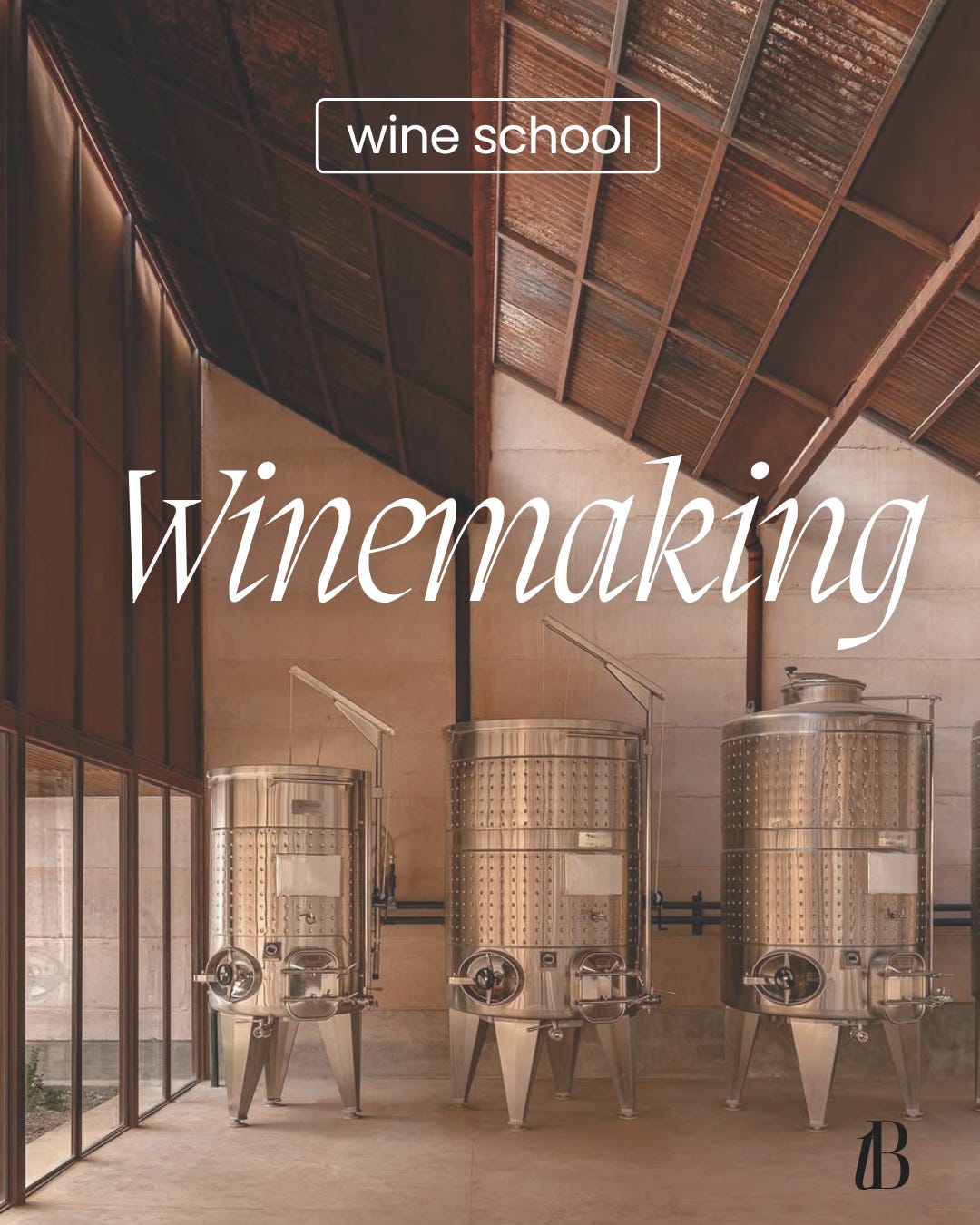
If viticulture is the process of translating place into fruit, winemaking is the process of translating fruit into wine. Grapes come into the cellar full of potential; what happens next determines whether that potential is amplified, manipulated, or occasionally… completely ruined!
At its core, winemaking revolves around one extraordinary natural process: fermentation
Sugar + Yeast → Alcohol + CO₂
That’s it. Fermentation is a metabolic miracle—yeast consumes sugar, produces alcohol and carbon dioxide, and in the process generates hundreds of aromatic compounds that give wine its character. Everything winemakers do either sets the stage for, guides, or reacts to this transformation.
How Grapes Arrive
Before fermentation even begins, winemakers make a series of important decisions:
Whole cluster vs. destemming: Using whole bunches (including stems) can add structure and herbal complexity; destemming gives a cleaner, more fruit-focused expression.
Crushing vs. pressing: Red wines typically get crushed to release juice and start fermenting on the skins; white grapes are usually pressed immediately to separate juice from skins.
Sorting: In higher-quality production, grapes are sorted to remove underripe or damaged fruit.
These choices set the baseline texture and flavor framework before fermentation begins.
Fermentation Choices
Fermentation can happen spontaneously, using the ambient yeasts present on the grapes and in the cellar, or through inoculation with cultured yeast strains. Each path has stylistic implications:
Spontaneous (native) fermentations are often slower, more variable, and can produce complex, distinctive flavors.
Inoculated fermentations are faster, more predictable, and allow winemakers to target specific flavor profiles or ensure reliability in large-scale production.
Temperature matters, too:
Cool fermentations preserve delicate aromatics (common in whites and sparkling bases).
Warmer fermentations extract more color and tannin (important for reds), and can lead to riper, bolder flavors.
Some producers guide the process closely: they agitate the mixture during fermentation to keep the skins and juice well-integrated, carefully manage temperature to control extraction and aromatic development, and sometimes add nutrients like nitrogen compounds or amino acids to keep the yeast healthy and fermentation on track.
Others take a lighter hand, letting the process unfold on its own with minimal interference. Both approaches are deliberate aesthetic and philosophical choices.
Post-Fermentation Decisions
Once fermentation is complete, the toolbox expands. A few key examples:
Malolactic conversion (MLF): A secondary bacterial process that softens acidity by converting sharp-tasting malic (like in a Granny Smith apple) acid into creamy lactic acid (like in sour cream). Common in most reds and many fuller-bodied whites (e.g., classic white Burgundy, California Chardonnay).
Lees contact: Leaving wine on the dead yeast cells (aka the lees) adds texture, savory complexity, and sometimes a subtle silkiness of texture.
Oak vs. steel vs. concrete: Aging vessels influence flavor and texture—oak adds structure and spice; steel preserves freshness; concrete offers neutrality with gentle micro-oxygenation.
Clarification and stabilization: Choices about fining, filtration, and sulfur additions affect clarity, shelf stability, and stylistic positioning (from squeaky-clean to unapologetically cloudy).
Each of these is a lever that shapes the wine’s final expression.
Winemaking as Philosophy
Two wines from the same grapes can taste completely different depending on the approach in the cellar. Some winemakers see themselves as minimal translators, intervening only to guide the process gently. Others see winemaking as a craft in its own right, with the cellar as a creative laboratory.
This is where style comes into focus: not just what the wine is, but how it’s made. And once you learn to recognize these choices, tasting becomes a way to investigate a complex matrix of creative decisions. Not to mention, you’ll have an easier time understanding your local wine merchant if they decide to speak only in industry jargon.
Tomorrow, we’ll take this system and apply it to a specific place—Burgundy—to show how environment and technique combine into a coherent style.
Do you have more questions about how what winemakers do? Drop them in the comments or hit reply. I’ll work some of your questions into future lessons.
And if you’re ready for the full thing—structured, sequenced, and free of gatekeeping—upgrade to Founding and get access to the complete Wine School as it rolls out.