
Recoding Orange Wine
How a centuries-old technique became a modern cultural lightning rod—and why the argument misses the point
Thirst Behavior is a project about wine, taste, and the social performances that form around them, the rituals of enjoyment shaped by status, media, money, and desire. Wine is the entry point; the real subject is how taste gets made, circulated, and contested, especially in New York and the Hamptons, where leisure and tastemaking overlap most visibly.
You can find my most recent feature here.
Friday features are always free, but if you want the weekly intel and ongoing education—plus to support independent wine writing that doesn’t do scores or sponsors—upgrade whenever it feels right.
If you’d like to work together or have consulting inquiries, pitches, or scoops, please email me at bodhilanda@gmail.com.
On a recent night at Le Dive, I did the thing I always tell people not to do.
I did not read the by-the-glass list with the wary concentration of someone about to spend $19 on five ounces of a stranger’s sensibility. I did not ask who made the wine, where it was from, what grape was involved, or how long it had rested on its skins in whatever vessel currently signals seriousness—steel, old wood, buried clay. I did not even ask to see the bottle.
Instead, I asked a question that pretends to be about wine but is usually about identity.
“Do you have an orange wine by the glass?”
“Yes,” the bartender said.
“Great, I’ll have one,” I replied, with a relief that should have embarrassed me.
The wine was not delicious.
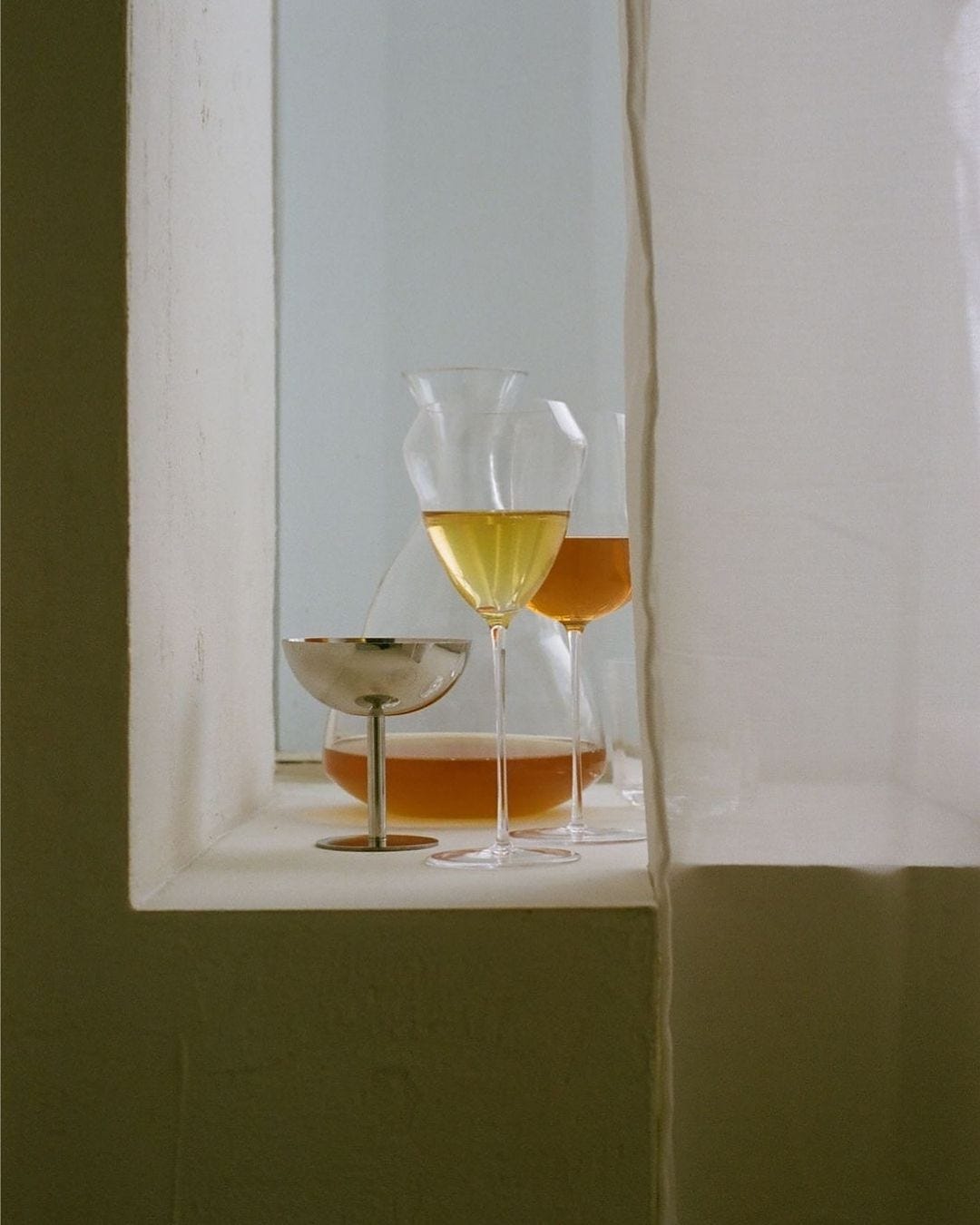
There are nights when I am not a wine writer, nor even an especially attentive diner. I am simply catching up with an old friend. I do not feel like pausing to scrutinize the list. I want to keep the evening moving. I still do not know what that wine was, and I do not fault the restaurant for pouring it. But I know this: I ordered a color as if it were a guarantee. I treated a method like a credential. I allowed a word, heavy with cultural meaning, to stand in for judgment. The disappointment was predictable. I had approached the list the way a tourist approaches a neighborhood—with a hunger for atmosphere and no appetite for specificity.
Orange wine has been coded far beyond its technical meaning. It is rarely permitted to be simply wine. It is asked to perform. In some rooms it signals fluency, ease, an understanding of the vibe. In others it is invoked as proof of decline—evidence in a broader indictment of natural wine, urban taste, or the erosion of standards.
The dominant narratives are not about how these wines taste. They are about what they signify. In the first, orange wine functions as a passive shibboleth of watered-down hipster culture—an amber accessory deployed as lifestyle décor. It has been memed to exhaustion: orange wine beside anchovy toast, orange wine in recycled stemware, orange wine as shorthand for downtown credibility, or innumerable nods to the ‘performative male.’ In that frame, the wine’s structure is irrelevant. What matters is that it reads correctly in the room or on the feed.
In the second narrative, orange wine becomes a symbol of dishonesty and mediocrity in contemporary wine culture. A recent piece in Vanity Fair, pointedly titled “The Case Against Orange Wine,” Byron Houdayer treats the category not as a spectrum but as a symptom. The article argues that wine “doesn’t need to be reinvented. Or orange,” and suggests that low-intervention styles undermine one of wine’s central virtues: harmony with food. The tone was less evaluative than prosecutorial. A handful of flawed examples were asked to represent an entire method. For all its rhetorical sparkle, it remains one of the dumbest pieces of wine writing I’ve ever encountered.
The problem with that framing is not that orange wine is beyond critique. It is that caricature is not criticism. To encounter several disappointing bottles and conclude that a technique itself is unserious is to mistake anecdote for argument. It is also to forget that mediocrity is hardly unique to skin-contact whites; it is evenly distributed across the wine world.
Jason Wilson, in Everyday Drinking, responded. His rebuttal did not canonize orange wine as virtuous. It made a simpler point. One can dislike certain wines without declaring war on an entire method. One can acknowledge the social theater surrounding a category without confusing that theater for the thing in the glass.
What these two positions share—hipster shorthand and cultural indictment—is a refusal to grant the category variation. In one narrative, orange wine signals inclusion; in the other, it signals corruption and, somehow, civilizational decline. Both reduce it to a cipher. Both flatten its range.
Stripped of its cultural charge, orange wine is straightforward. It is white wine made with skin contact. White grapes are typically pressed off their skins quickly; red grapes ferment with them. Orange wine treats white grapes like red ones. The skins remain in contact with the juice for hours, days, or months. The result is deeper color, added tannin, textural grip, and an expanded aromatic spectrum—citrus peel, herbs, resin, dried fruit, black tea, dead flowers, baking spice. Beyond that, everything depends on decisions: duration of maceration, oxygen management, cleanliness in the cellar, sulfur choices, intention.
There is no single flavor of “orange wine.” There is only technique applied well or poorly.
The modern revival that shaped American perceptions runs through Friuli and Slovenia, though the method itself is geographically and historically expansive. Simon J Woolf, in his book Amber Revolution, has documented that revival with the seriousness it deserves, treating skin-contact wines as a global subject rather than a passing urban mood. That framing is important because it restores scale. It situates orange wine within craft and geography instead of trend and backlash.
The easiest way to recode orange wine is to insist on difference. Gravner and Radikon, both in Friuli, pursue radically distinct expressions of skin contact—one austere and architectural, the other more kinetic and aromatic. Paolo Bea in Umbria integrates skin contact into a broader traditional vocabulary of time and oxygen. Even within a single region, the range is substantial. Once you speak in terms of producers and structure rather than color, the abstraction dissolves. You are back to tasting wine.
The binary persists because it is convenient. If you love orange wine, you can order it blindly and feel aligned. If you hate it, you can dismiss it wholesale. Both positions spare you the effort of discernment. But no winemaking method can be reduced to its worst examples any more than red wine can be reduced to tepid Kirkland Merlot, or plonky, glou-glou hipster-juice. When a skin-contact wine disappoints, it is not evidence of conspiracy. It is evidence that someone made a wine you did not enjoy, and perhaps, they’re trading on a trend.
So I suggest you clear your head of everything you think you know about orange wine and start over. Go to Kafana, a Serbian restaurant and wine bar whose list folds skin-contact wines into a broader Eastern European idiom. There, orange is not an obligatory subsection. It appears alongside other regional expressions as one method among many. You order by grape, by place, by producer, and only incidentally by color. In that context, the abstraction dissolves. Skin contact ceases to be a signal and returns to being a choice.
Do not do as I did. What I remember most from that night at Le Dive is the relief I felt when the bartender said yes. The word “orange” had become a shortcut, a way of avoiding the small vulnerability of reading a list and admitting uncertainty. It functioned as social insulation. It allowed me to feel aligned without having to think.
Wine rewards the opposite reflex. It rewards attention. It rewards curiosity about grape, place, and process. It rewards the willingness to ask a slightly nerdy question in exchange for a better glass.
Orange wine does not need to be redeemed or condemned. It needs to be recoded. It is a technique with history, variation, and uneven results, like every other technique in wine. The distortion begins when color replaces discernment. The correction is simple: treat it with the same specificity you would grant any serious category, and most of the noise recedes.
One can imagine re-reading this essay substituting "rosé" for "orange," because pink is often treated in aggregate rather than in specific.
"I'll have the Chablis."
"I'll have the Sonoma Coast Pinot."
"I'll have the Gravner."
"I'll have THE ROSÉ."