
Thirst Behavior is a project about wine, taste, and the social performances that form around them, the rituals of enjoyment shaped by status, media, money, and desire. Wine is the entry point; the real subject is how taste gets made, circulated, and contested, especially in New York and the Hamptons, where leisure and tastemaking overlap most visibly.
You can find my most recent feature here.
Friday features are always free, but if you want the weekly intel and ongoing education—plus to support independent wine writing that doesn’t do scores or sponsors—upgrade whenever it feels right.
If you’d like to work together or have consulting inquiries, pitches, or scoops, please email me at bodhilanda@gmail.com.
In 1986, NBC aired Kate’s Secret, a made-for-TV movie in which Meredith Baxter Birney plays a suburban housewife hiding her bulimia from her family. I have not seen this, and I probably won’t, but by the description, it sounds like a tidy little morality tale about a woman coming apart, and embracing her imperfections, and beginning recovery. Forty years later, John Early has made a film called Maddie’s Secret about a millennial food content creator whose professional life provokes a flare-up of long-latent eating disorder.
I was only cursorily familiar with John Early’s work before I saw this film last week. I found a lot of it superficially chuckle-worthy, but largely evasive — an endless, vexing stack of meta-jokes that seem to redound, above all, to meaninglessness. That he’d chosen food media as the subject of his directorial debut obviously piqued my interest. Seeing promo content where he talks to Alison Roman about how food videos on Instagram have assumed the visual rhetoric of pornography, I wondered what Early might add to the conversation. I, like many in my métier, arrived to the film ready to be flattered by way of roasting. That didn’t happen.
Maddie’s Secret is not a good satire of food media. It is not a good film about eating disorders. It is not a convincing psychological portrait of a woman in crisis. It gestures toward all three but declines to deliver on any of them. It is a messy pastiche of 2010s food media tropes, with nonsensical references to buzzy ingredients of the era: Meyer lemon, yuzu kosho, turmeric. The references are so obvious — Bon Appétit’s Test Kitchen, The Bear, the chauvinist media exec who would have met his demise in the #MeToo era — that anyone hoping for an incisive critique of that world is more likely to feel insulted than seen. Likewise, anyone hoping for a fresh take on disordered eating from the vantage point of the Ozempic era would likely have left just as unsatisfied.
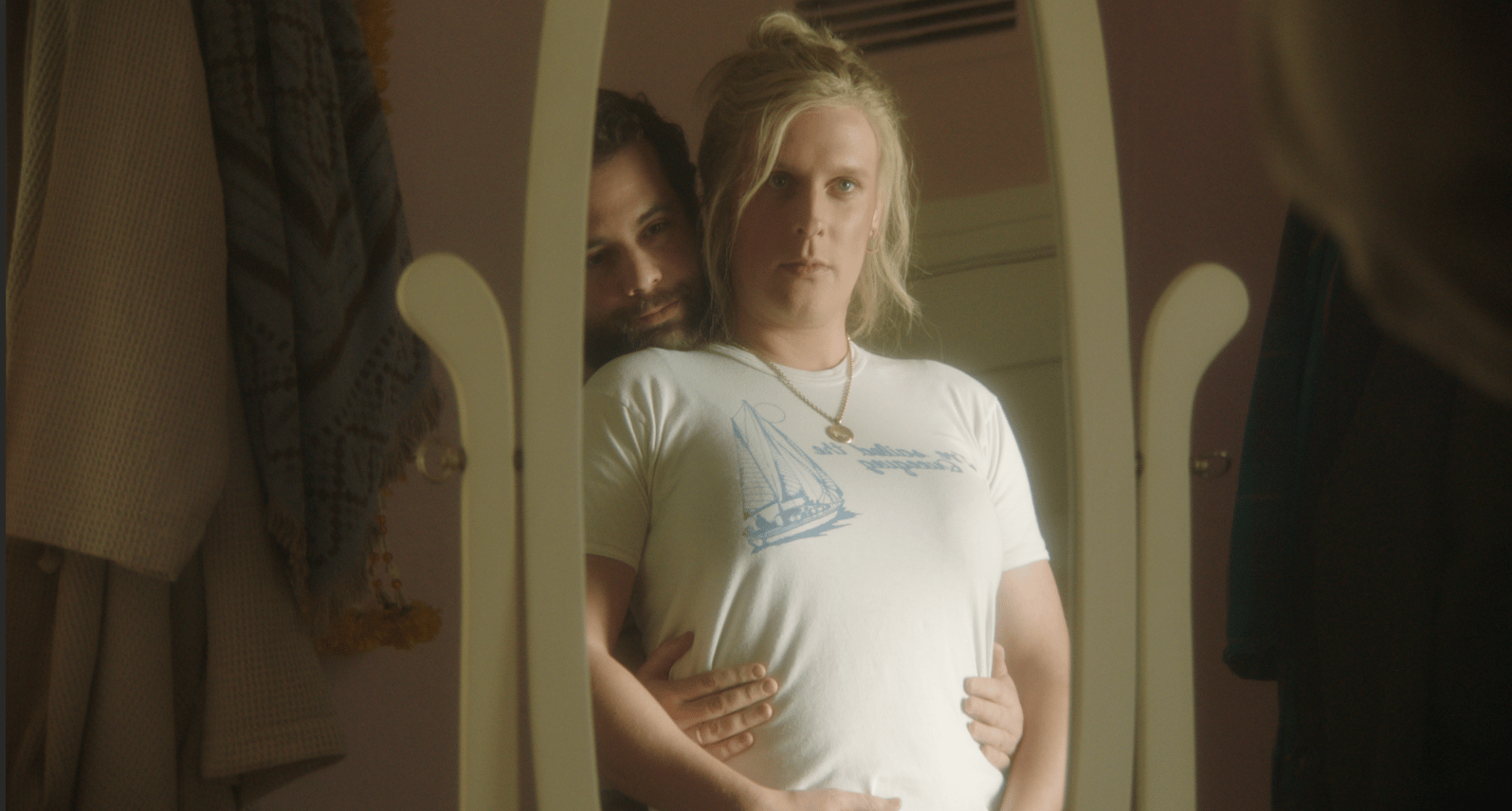
But the film is not about food media, influencer culture, or eating disorders. What it actually is, beyond its plot machinery, is a performance built entirely out of other performances, and a total subversion of genre.
Early’s performance as the titular Maddie unfolds as a succession of instantly recognizable emotional poses presented as clichés: the coy deflection of praise; the carefully measured confidence that evaporates the moment she’s alone; the gasping orgasm; the grief-stricken collapse to her knees in the inpatient ward. These scenes propel the narrative forward, but they also function as citations of a genre we’ve all become painfully fluent in.
The strange thing is how the film’s emotional registers keep inverting. I found some of its most ostensibly serious scenes — the dramatic exposé of Maddie’s mother’s abuse, for instance — to be the funniest. Some of its campiest, stupidest moments, like Maddie discovering embodiment in a radically inclusive queer dance class, were genuinely moving. The film never settles into a stable relationship with its own material. You keep laughing at things you’re supposed to feel, and feeling things you’re supposed to laugh at.
Maddie is less a character than an archive of modern feminine imagery. More than any of the film’s alleged subject matter, it made me think about Cindy Sherman.
Sherman’s photographs never simply depict women. They depict the accumulated images through which women have already been represented in popular culture. As Laura Mulvey writes, Sherman transforms herself into “a glossary of pose, gesture and facial expression,” assembling figures from cinema, fashion photography, melodrama, and advertising — from the visual debris of twentieth-century femininity — rather than from any stable interior identity. John Early is attempting something remarkably similar. The film doesn’t ask whether Maddie’s performances are authentic. It asks how they became recognizable in the first place.
The performance never attempts to erase Early’s own body. The film could have pursued a convincing illusion of femininity if it wanted to — or, you know, cast a woman in a film supposedly about women’s issues. It doesn’t. Every emotional crescendo is quietly interrupted by the same undeniable fact: Maddie is visibly John Early in a wig. The interruption is never played as a punchline, and the film never asks us to overlook it. Instead it becomes the mechanism through which the whole project operates. We never stop seeing Early. We never entirely stop believing Maddie. Mulvey describes something similar in Sherman’s photographs, where the viewer continually oscillates between seeing Sherman herself and seeing the feminine archetype she has assembled. The illusion never stabilizes, because the construction stays visible.
That oscillation is what makes the film’s emotional life so unpredictable. Sometimes you see Maddie — the earnest dishwasher, the wounded daughter, the perfectly imperfect millennial food personality — and the feeling lands. Sometimes you see John Early, fully committed to a performance of someone who is so obviously fake, and that commitment is itself the thing that moves you.
I’m still not sure why the dance class scenes affected me the way they did. On paper it’s flagrantly silly: John Early in drag finding catharsis in choreography, surrounded by a cast of characters so pointedly diverse they could have been focus-grouped in 2013. It should collapse under its own ridiculousness. And yet I felt something real watching it.
I saw John Early, not as a performer inhabiting someone else’s script, but as a writer building himself a room to stand in. There’s a version of this that Clint Eastwood has been doing for fifty years: constructing the scenarios, the redemptions, the moments of moral clarity that let him enact his own fantasies of masculinity, then stepping in to perform them himself. Early’s dance class felt like a version of that same move, run through a different set of fantasies — embodiment, acceptance, a room full of people cheering you into your own body. Call it his own phantasmatic identification, his very personal exercise of diva worship. What moved me wasn’t Maddie’s catharsis being performed by Early. It was Early borrowing Maddie’s narrative long enough to stage something he wanted, or needed, to experience himself.
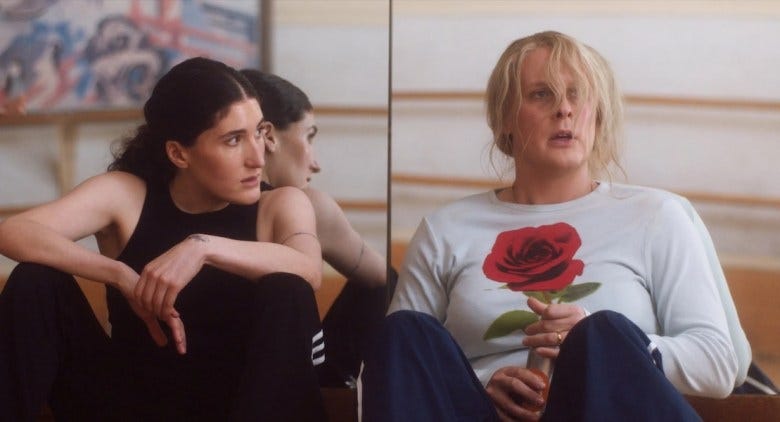
Oscillation reshapes what the film seems to be about. Maddie’s bulimia initially appears to function as the psychological explanation for her relentless pursuit of perfection. But the more the film leans on familiar eating-disorder iconography — the furtive bingeing, the purging — the less interested it seems in the condition itself. The body becomes another representational problem, another image under pressure — the coherent, photogenic Maddie giving way to something that won’t hold its shape. Mulvey describes Sherman’s later work as dismantling the cosmetic surface of femininity, replacing polished appearances with bodily fluids, grotesque transformation — a “phantasmagoria of the female body.” Maddie’s Secret stages its own small version of that disintegration. Bulimia doubles here as narrative engine and the film’s most literal image of it’s own incoherence.
This is why I don’t see the film’s “failures” as incidental — they’re structural, and they’re necessary. A convincing satire of food media, or a genuinely affecting eating-disorder drama, would have resolved Maddie into a coherent psychological arc. Coherence is exactly what the oscillation can’t survive. The film has to stay a mess, because a tidy Maddie is a Maddie that Early risks disappearing into.
This is what Jack Halberstam calls “the queer art of failure.” Halberstam argues that failure can be its own kind of politics — a refusal to succeed on terms set by dominant culture, and in that refusal, a way of exposing how coercive those terms actually were all along. Early’s Sherman-esque drag that never fully convinces, and never resolves, feels aligned with this project. Maddie’s Secret isn’t incompetent. It’s refusing a certain kind of legibility. It fails at food media, at trauma narrative, at psychological realism, for the same reason: competence would be way too easy.
Maddie herself is barely a character — a caricature assembled out of other women’s crises, other women’s recoveries. What’s amazing is Early’s devotion to her anyway: total commitment to someone who was never meant to convince anyone. Genre, here, is a ruse — a shape borrowed long enough to get him a room where the real representational work happens. But even that reading doesn’t hold for long. In the end, Maddie takes off. I don’t know if that’s Maddie evading her own diagnosis, or Early evading mine. Either way, the film seems intent on outrunning us.