
Is Menswear Cooked?
Dressing well used to signal taste, intelligence, and belonging. In an era of frictionless style, it mostly signals that you know how to follow instructions.

In 2026, I’m going to dress more boring.
After about a decade-long hiatus, I’m returning to jeans. I recently bought a charcoal gray knit turtleneck from Quince and found it genuinely thrilling. I own a pair of fur-lined L.L. Bean loafers. I am, now in the twilight of my thirties, beginning to dress my age.
This is not a declaration of aesthetic surrender. I am not renouncing taste, nor retreating into dadcore. When I say boring, I mean boring in the sense of not wanting my clothes to say very much at all.
That desire—to wear something solid, competent, and quiet—turns out to be less trivial than it sounds. It points to a broader shift in how clothes function, at least for men my age. This isn’t a shift away from caring how we look, exactly, but a shift away from asking clothing to perform so much symbolic labor on our behalf.
I’m not entirely sure what’s driving it. It could be that my lifelong struggle with masculine gender presentation has reached a point of soft, unceremonious resolution. It could be the ambient fatigue of having lived through several complete cycles of men discovering trousers. It could be the psychic shock of watching my fifteen-year-old nephew post photos of himself wearing JNCOs, which somehow look both aggressively current and historically recursive at the same time. Whatever the cause, the effect is consistent: for the first time in my life, I’m looking to look more basic.
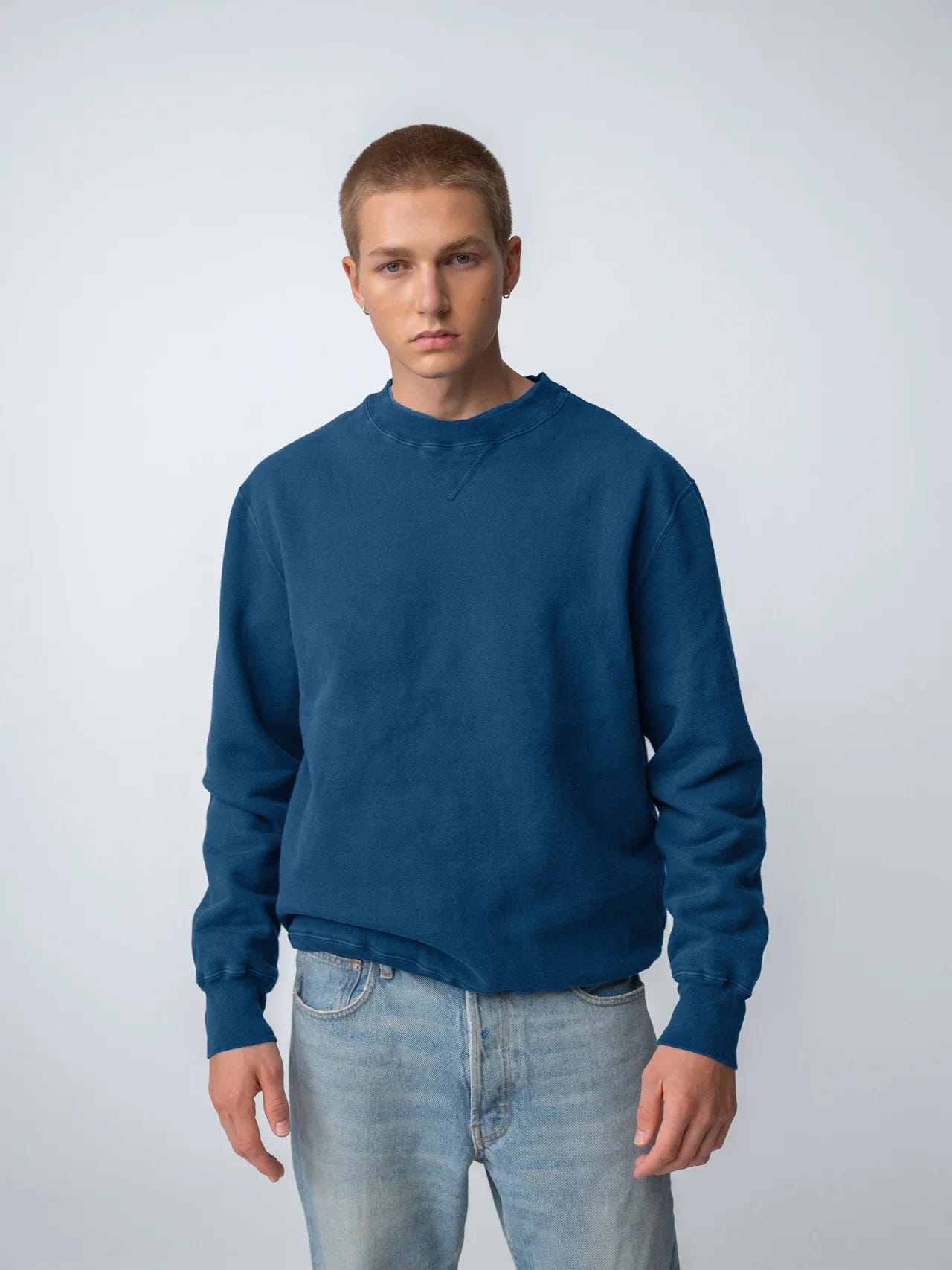
So, I’m very hyped on this sunwashed crewneck sweatshirt from Hanover. It is one hundred percent cotton, made in America, garment-dyed, pre-washed, logo-free, and under a hundred dollars. I don’t love it because it signals good taste. I love it because it signals nothing in particular. I want it not because it promises to make me look interesting, but because it promises to stop asking me to perform interestingness with a sweatshirt.
Dressing Your Age, Dressing at All
Dressing your age has less to do with your age than with how long you’ve been trying things on. It’s not about conservatism, nor about abandoning style in favor of respectability. It’s about recognizing when clothes stop being a place to prove something new about yourself. To dress your age, in this sense, is to understand when the audition is over.
For millennial men, menswear once functioned as a kind of ongoing tryout. You dressed to demonstrate that you were paying attention, that you understood the references, that you had internalized the right lessons about fit, proportion, silhouette and restraint. The ideal outcome was to look fluent without seeming desperate.
That posture made sense when access to taste was uneven—when knowing how to dress still implied knowing where to look and who to listen to. Menswear circulated through stores, magazines, forums, and scenes that required time and proximity to enter. In that context, dressing well really did function as evidence that attention had been paid. Coolness, at least provisionally, felt earned.
But at a certain point, continuing to dress as if you’re still auditioning starts to read like insecurity. You can feel it in outfits that seem over-resolved, assembled with the clear expectation of being decoded. The clothes arrive already anticipating commentary—he knows who Evan Kinori is, and he can afford to put that sh*t on—and in doing so, they flatten the person wearing them.
Dressing your age isn’t necessarily about toning it down. It’s about withdrawing from the performance loop. It’s the decision to stop using clothes to certify your belonging, because belonging is no longer the question at hand. The interesting work has moved elsewhere.
When Taste Gets Too Easy
Everyone now knows what to buy, how to wear it, and what it is supposed to signal. And yet the outfit rarely explains much about the person wearing it beyond the fact that they know how to dress. Taste, in clothes as in any other realm, has become frictionless.
You can learn it by scrolling. You can absorb it through archive accounts that collapse decades of differentiation into moodboards. You can acquire it through resale platforms that flatten access while preserving the appearance of discernment. Knowledge is no longer something you earn slowly, through proximity and context. It’s something you download in an afternoon with just a few smartphone apps.
When taste can be executed step by step, it stops doing the work it once did. Clothes no longer hint at interior life so much as confirm procedural competence. The result isn’t bad dressing, but correct dressing—outfits that, at their best, scan perfectly, but still say very little.
This is why hyper-articulated aesthetic choices increasingly read as just that: aesthetic choices. They’re not expressions of curiosity or contradiction, but demonstrations of fluency within a system that no longer withholds anything. The consumer decisions speak fluently. The person underneath remains curiously unexamined.
I think about the guys who get tattooed instead of cultivating interesting perspectives. Your friend’s boyfriend who shows up to the party with a liter of skin-contact Gulp/Hablo like it’s a flex. Tech founders swapping Patagonia vests for Palm Angels tracksuits and Chrome Hearts tees. Meanwhile, Jonathan Anderson—someone with unimpeachable fashion credentials—shows up to public appearances in normal-looking jeans, tennis shoes, and a plain sweater. He is masterfully underdressed, not because he lacks taste, but because he no longer needs his clothes to perform it for him.
Taste Goes Private
In a recent i-D piece, Nicolaia Rips wrote, “your taste should be private.” Her argument is that the most interesting functions of taste may no longer be public-facing. In a fully optimized recommendation economy—where every preference can be surfaced, categorized, ranked, and monetized—public taste flattens. It becomes instrumental. It turns into a dataset.
What survives is personal taste: quieter, harder to translate, uninterested in recognition. Taste that shows up in repetition rather than declaration. As an example, she points to The Errands Show, an Instagram project that documents what people wear while running everyday errands, when they’re not performing a curated consumer identity. A young woman goes to get a dress taken in and notices the weed leaf on the pulled-up sock of her tailor. You know, amazing stuff like that. It’s absolutely mundane—and somehow more interesting than ninety percent of reels on Instagram. It shows us taste operating at a low frequency, embedded in daily life rather than staged for attention. The outfit is chosen, but it isn’t addressed outward. It doesn’t ask to be decoded. It doesn’t care who’s watching. Some people look effortlessly good, others don’t!
The intrigue of the show, and Rips’ argument about the interiorization of taste, is the flip side of my current menswear malaise. The work clothes once did—signaling intelligence, curiosity, interiority—has moved into smaller, less visible decisions, like how someone speaks, what they repeat and what they reach for when they’re not trying to be seen.
Normcore, After the Fact
Is all of this a normcore renaissance? No. The silhouettes overlap. The materials feel familiar. The affect is similarly muted. But the resemblance is misleading.
When K-Hole published Youth Mode in 2013, normcore wasn’t a retreat from meaning but a reorientation of it. It emerged as a response to what they called Mass Indie: a culture in which difference had become so finely specified, so relentlessly curated, that it collapsed into exhaustion. Identity had become a high-resolution problem. Everything mattered, all the time.
Normcore proposed sameness as a way out. By opting into the middle—into clothing that refused distinction—it offered a strategy for connection. If Mass Indie was about proving difference, normcore was about suspending that proof. The sameness was outward-facing. It was an invitation.
What we’re seeing now feels like the aftermath of that strategy rather than its continuation. The plain sweatshirt today doesn’t read as adaptive or generous. It reads as a boundary. It isn’t “I can be with anyone.” It’s “I don’t want to be read too closely.”
Normcore was sameness as openness. This moment is sameness as withdrawal from the constant demand that clothes perform legibility, relevance, and self-knowledge. The goal isn’t connection through neutrality, but privacy through opacity.
After the Signal
The creative force behind Hanover is Chris Black, and he is not a person lacking taste, nor someone retreating from fashion out of disinterest. He is one half of the podcast How Long Gone, a longtime columnist at GQ, and a creative advisor to major menswear brands, like J.Crew. He has spent years inside the machinery of taste—watching how meaning gets produced, circulated, and eventually exhausted. If anyone understands how easily even restraint can harden into posture, it’s him.
This is why Hanover’s blandness—or, let’s say, refusal to perform—feels intentional, and compelling. It isn’t saying this is what cool looks like now. It’s saying cool no longer needs to live here.
I spotted Chris recently on a weekend upstate. He was wearing a puffer jacket and athletic shorts, walking to get coffee. If you didn’t know who he was, you might have written him off instantly. Another basic rich city guy wearing overpriced athleisure on vacation. But the moment he opened his mouth, I realized who he was. The voice gave him away.
This is how it should be.
Hanover doesn’t mourn the collapse of menswear’s signaling function, and it doesn’t try to resurrect it through irony or archive, it doesn’t re-imbue the crewneck with cultural significance. It accepts that the work clothes once performed has migrated elsewhere—into the low-frequency decisions that don’t scale well or screenshot cleanly.
Dressing boring now means accepting the possibility of being misread. It means letting go of the idea that your clothes should preemptively explain you. If someone is paying attention, they’ll figure it out. If they’re not, that’s no longer your problem.
For straight women we often have to perform for the male gaze when we make dressing choices. Dressing boring has also helped me become invisible to the male gaze and it is thrilling. Like I could commit crimes and nobody would see me.
I have always lived in a rural area, dipping into the metropolis only as a visitor. The codings and signals of urban style have always felt elusive, and I always end up feeling like a bumpkin regardless of my wardrobe.
In the North Country the aesthetic is decidedly understated, down-market, cheap, even worn-out, but that itself is a signal. Carhartts and Johnson Woolen Mill hunter plaid say "I'm from here and not trying to stand out." Anyone wearing lipstick gets a look like "Who the hell does she think she is?"
That said, people dress down but the accessories are another story, jewelry, especially. You may be wearing a stained Hanes cotton tee but have the latest Garmin on your wrist. You may be wearing a cheap yoga top from Amazon (they have the most bizarre brand names, like YAZZNOQ or whatever) but you're also wearing a 1-carat diamond stud in each ear. The clothing is noise. The jewelry is signal.
One more thing and I'll stop. I have a friend who is an inheritor of vast generational wealth. We're talking own-two-major-islands level wealth. I have never seen her in anything but jeans and a tee shirt, plus a sweater she loves, cashmere, that her wife bought her because it matched her eyes. I saw her wear a dress only once, on their wedding day (the wife made their dresses). She does not wear jewelry, except her wedding ring (she is sadly a widow, now). She does not need to signal anything to anyone. In fact she has ardently striven, her entire life, not to signal anything to anyone. It was the family aesthetic, part of the training.