

Thirst Behavior is a day late today because I chose to go to the beach yesterday. Sorry! Today’s letter: how to be a somm. A little professional autobiography, a little field manual, and a few things I wish someone had told me fifteen years ago—back when the job still meant memorizing Burgundy villages out of a binder and smelling citrus fruits in the produce aisle. Here we go:
My friend and summer colleague just passed his Certified Somm exam, and now he’s off to work harvest at Hirsch. It’s been fun to watch him navigate this period of growth: first getting the facts straight, then exploring how to speak authoritatively, then adjusting to simplify and make his knowledge more accessible to others. Like so many things that happen here, it made me reflect on how the job actually works. There’s a difference between what people imagine a sommelier does and what the role really requires—not in the literal sense (yes, hospitality is labor, and learning wine requires a lot of study), but in the way it tests your personality: your attention span, your ability to absorb and translate technical knowledge in real time, and to do it all in a voice that isn’t trying to prove anything. I’ve been doing this for as long as many of my teenage bussers have been alive, and it still happens more often than you’d think that someone looks up a from the wine list and says, “You’re the somm?”
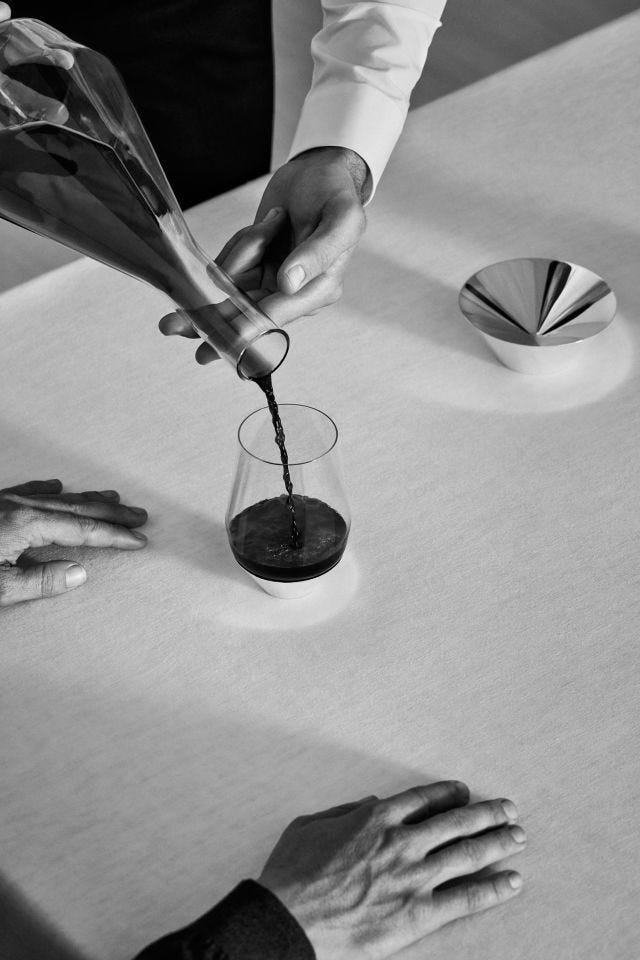
When I was a bit younger, I used to understand this as ageism, but it’s far more common now to see a 22-year-old sommelier running the floor at a hip restaurant than it was when I started. The industry has changed enough that the performative markers of expertise have collapsed a bit—a sommelier no longer needs to look like a guy in a three-piece suit and a Zegna tie holding a saber. And while I take the work (somewhat) seriously, I can’t imagine anything more corny than wearing a sommelier pin in the dining room, even back when I had a suit-and-tie somm job. Still, the ghost of that old-school snobbery lingers in the guest’s imagination. If I don’t seem sufficiently grave or ego-forward, it can throw people off. Occasionally, someone who’s seen the Jason Wise film will follow up with, “What level are you?” as if there’s a global tier system that confers authority on anyone who’s passed a test. It feels like they want me to describe my credentials like some video game avatar—a Level 9 Diablo Paladin, specced in bottle service, premature oxidation, and minor tableside de-escalation. Strong against Brett. Weak to brunch. This brings me to the first point:
It’s a job, not an academic degree.
The performance of the work is what gives you the title, not the certificate you get. I don’t say this to dismiss wine eduction. I always recommend people take a certification course if they want to work in restaurants, not because the pin matters, but because the material is essential. You do need to learn the grapes, the regions, the structure of it all. You do need to understand why Chablis tastes the way it does, and what it means when someone says they like “earthy” reds, or “buttery” whites, even if those descriptors make you flinch. But the credential itself doesn’t make you a sommelier. The title is conferred by the work. You’re not a somm because you passed a test. You’re a somm because you do wine service in a restaurant. That means you’re responsible for pacing, presence, problem-solving, and occasionally plunging your entire arm into an ice well to recover a forgotten bottle of Pinot Grigio. It means you know how to move through a dining room at speed without disturbing the rhythm of a guest’s conversation. It means you can open Champagne in a tight corner, then pour it evenly for 6 guests. It means you can sell with conviction even when the wine is weird. And it means you understand people more than you understand wine.
Pronunciation matters more than you think.
You should still study, of course. A lot. But the thing no one tells you is that most of that studying needs to happen out loud. There’s nothing that undermines your credibility faster than tripping over the name of the thing you’re supposed to know a lot about. You do not need to pronounce every region in a perfect local accent—and, frankly, I’d prefer you didn’t. But if you're working with these wines, you do need to learn how to say them passably, and with confidence. Montrachet. Chiroubles. Pouilly-Fuissé. These are not rare birds. If a VC in Loro Piana loafers is looking at you expectantly while holding the wine list, and you panic and trip over Latricières-Chambertin you’ve already lost. Even the most Reddit-pilled hobbyist wine bros know this. Study out loud. Speak like you belong. Don’t let pronunciation be the reason someone decides not to trust you.
Start with the classics
If you’re serious about this work, get a job somewhere that sells the classics. Not because they’re better, but because they’re useful. You should understand what wine is before you get too opinionated about what it’s not. Working in a restaurant that sells Bordeaux, Burgundy, Barolo, at real-world price points, will teach you more than any natty list full of orange wine made in trash cans (no shade). You’ll learn how wine performs socially. You’ll learn how people make choices when they feel insecure, or generous, or afraid of being embarrassed. You’ll learn how to sense what someone wants to spend before they say it. You’ll learn to look at shoes and watches and whether someone orders still or sparkling as an opening data set. You’ll be wrong sometimes. You’ll make assumptions that backfire. But eventually you’ll develop the kind of pattern recognition that makes service work intuitive. You’ll be able to drop a bottle on a table doing that annoying thing where you ask, “where do we want to be, price-wise?” because you’ll already know. That’s not snobbery—it’s just data, refined through exposure. Work with classic wines and the people who enjoy them in order to develop your intuitions compass.
Spend time in the cellar
Spend time in the cellar. This is usually the job of the junior somm or assistant, and it’s a good one. Seeing wine on a spreadsheet is one thing. Seeing it on the shelf—logging it in, physically touching it, double-checking the vintage against the label—makes your knowledge three-dimensional. Do the inventory yourself if you can, and handle every bottle. Print the bin labels. Organize the backup fridge. Build the metro shelves. Configure the POS. This is how the map gets etched into your nervous system. And when the wine you’ve received, tagged, chilled, listed, and then poured finally gets described back to you by a guest—“this is really good”—you’ll understand the whole arc of the job. Wine comes into the building as product. You convert it into experience. That’s the work.
There’s a version of this essay that’s just a list of hard skills: carrying twelve bottles down the stairs at once; flash-chilling a bottle you forgot to stock; pouring at an awkward angle while dodging a runner with a tray full of oysters. I could write a whole CV out of this stuff, and maybe one day I will. But the point is this: being a somm isn’t as much about your taste as it is about organizational and communication skills. It’s about doing whatever is necessary to make sure a wine someone will love arrives at the table in good condition, at the right moment, with the least possible friction. It’s about identifying the signal of what someone wants before they know how to ask for it. This is where we get to the main trick of the trade.
Reverse engineer understanding
Half the time, guests don’t have the language to tell you what they like. So I ask them to tell me about a wine they’ve enjoyed before. Doesn’t matter what it is. I’ll listen, translate whatever they say into something structurally coherent, and repeat it back in more useful terms. “So you’re into wines with velvety texture.” Or “You want something crisp with a little citrus pith.” Or “You like a touch of green pepper on the finish.” I plant a seed. I give them something to look for. Then I recommend a bottle that matches that re-description, ideally at a price point, they’re comfortable with. And when they find the thing we talked about in the glass—and they usually do—they get that little click of recognition. That’s the part people actually enjoy. It’s not the geological content of the soil, or the elevation of the vineyard, or even really the flavors in the glass. It’s that sudden moment of clarity: the thrill of recognizing something beautiful you didn’t know you had the words for.
In Other News
Pretending to Be Unpretentious — The perennial “pretense in winespeak” debate is alive and well, with a new generation of natural wine bars convinced they’ve finally cracked the code for making wine “accessible.” Wine Enthusiast profiles Rude Mouth and sommelier-founder Ava Trilling, whose approach is—get this—less about the wines and more about how they’re presented (yeah, no shit!). Sometimes it feels like wunderkind somms think the rest of us are out here holding our guests at gunpoint until they agree to spend a few bands on Coche-Dury Meursault. Hold up. You’re telling me its important that your guests feel comfortable?
Eater Layoffs — Apparently they had employees? Outside of ad sales? Fifteen people gone in one swoop, including regional editors and a large portion of their union labor, in what the Vox Media Union calls a “major restructuring.” Cynics might see it as capitulation to a bleak AI futurism; optimists might note that AI can probably do “27 Must-Try Negronis in [Your City]” just as well, maybe with fewer typos.
Song of Chloris Opens at Galerie Sardine — Today in Amagansett, Galerie Sardine debuts Song of Chloris, with Ida Ekblad’s dense, impasto paintings, Erin & Sam Falls’s plant-imprinted ceramics, and Pali Cornelsen’s Brazilian modernist-meets-minimalist furniture. Expect contemporary aura objects from the Bradley/Akerman business empire: tasteful, impeccably produced, and destined for Hamptons homes with a discreet wine fridge.
I Cavallini — The new spot from the Four Horsemen team is open. I haven’t been yet, but I’m taking bets on the by-the-glass list featuring at least one salty Ligurian white and one skin-contact Friulano, plus a bottle section hiding a deeply funky Bonarda from Emilia that someone will claim is “basically Lambrusco.” If you’ve been, I want to know: what’s pouring, how the room feels, and whether the lighting is flattering or just dim.
That’s it for this week. I’m beginning to develop an online training program for wine. I’m not exactly sure what shape it’ll take yet, but the idea is for it to be casual (“unpretentious,” if we must) while still being complete—a kind of prerequisite course you can keep around for easy online reference. Think of it as the essential foundation for understanding wine without having to wade through a bunch of gatekeeping nonsense. If you’d be interested in learning wine from me, I’d love to know—especially what kinds of topics you’d want to go deep on. And as always, if you have your own definition of what makes a somm, or a story about your best (or worst) bottle recommendation, hit reply and tell me.
"The title is conferred by the work. You’re not a somm because you passed a test. You’re a somm because you do wine service in a restaurant. "
I've written that so many times, for so long, I literally thought you were quoting me. Turns out, we just agree a lot!