
Thirst Behavior is a project about wine, taste, and the social performances that form around them, the rituals of enjoyment shaped by status, media, money, and desire. Wine is the entry point; the real subject is how taste gets made, circulated, and contested, especially in New York and the Hamptons, where leisure and tastemaking overlap most visibly.
You can find my most recent feature here.
Friday features are always free, but if you want the weekly intel and ongoing education—plus to support independent wine writing that doesn’t do scores or sponsors—upgrade whenever it feels right.
If you’d like to work together or have consulting inquiries, pitches, or scoops, please email me at bodhilanda@gmail.com.
The Knicks are up 3-1 as I write this. Game 5 is tonight in San Antonio. By the time you read it, maybe the Knicks will have secured the title of champions, or — in a better world, I’d argue — they let the Spurs have another one, so they can win game 6 at home. I have no predictions because I know that sports have a way of humiliating anyone foolish enough to discuss them in public while the series is still live. But the possibility is real enough that New York has started to imagine a scene it has not witnessed in more than fifty years: not the trophy presentation, not the parade, not the brawls in Central Park (those have already happened), but the champagne shower; that glorious ritual in which twenty young men in peak physical fitness spray each other in the face with expensive sparkling wine from huge bottles.
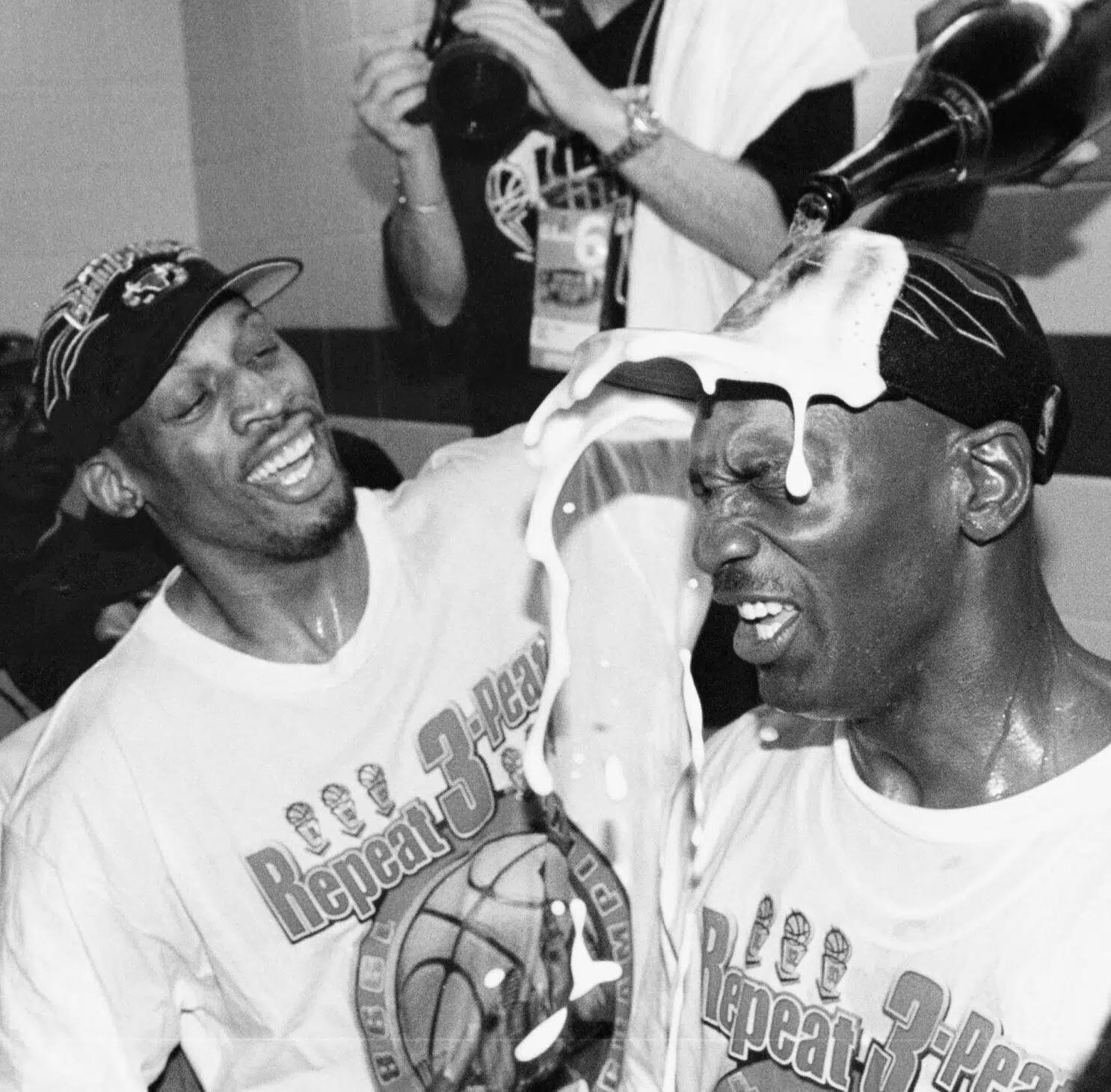
I was very young when I first saw Michael Jordan drench Scottie Pippen with what I would later learn was roughly four hundred dollars’ worth of Dom Perignon. The Bulls had just won their third consecutive title, and the locker room had transformed into something I had no vocabulary for. I watched these broadcasts the way children watch anything adults seem to care about, which is to say with total absorption and almost no comprehension. The players had changed into their commemorative championship T-shirts, which were already soaked through and clinging to their bodies. Magnums were being shaken with the aggressive enthusiasm of children operating Super Soakers, and the champagne exploded forth as white foam, arcing across the room in thick streams that caught the glint of the television lights. These young men screamed and embraced. They poured champagne directly into one another’s open mouths from a distance of several feet, much of it missing and cascading down their bodies. The whole scene vibrated with a certain erotic charge that even a child could detect. Though I couldn’t name it exactly, I could sense that whatever was happening in that room was somehow more real, more consequential, more immediate than the polite trophy presentation that had preceded it.
I watched versions of this scene repeat through the Rockets championships, through the Spurs and Lakers dynasties, year after year. The ritual was so consistent that it began to seem inevitable. By the time I got to middle school, I would be disappointed to learn that the locker rooms of real life carried far less of these gay Dionysian orgy vibes, and more just, run-of-the-mill harassment from jocks. Where, I wondered, was the wild abandon, the communal ecstasy, the chaotic jouissance of the locker rooms on television? Was this only available to Hakeem Olajuwon and Clyde Drexler, or could such an event be arranged for, say, the sixth graders of North Middleschool’s B-Squad basketball team, who’d won only a single game that season? Turns out the answer was no.
I lost touch with the NBA as I entered my teens, but the memories of champagne showers stuck with me as a bizarre anthropological phenomenon, loaded with meaning but underdiscussed. Where did this come from?
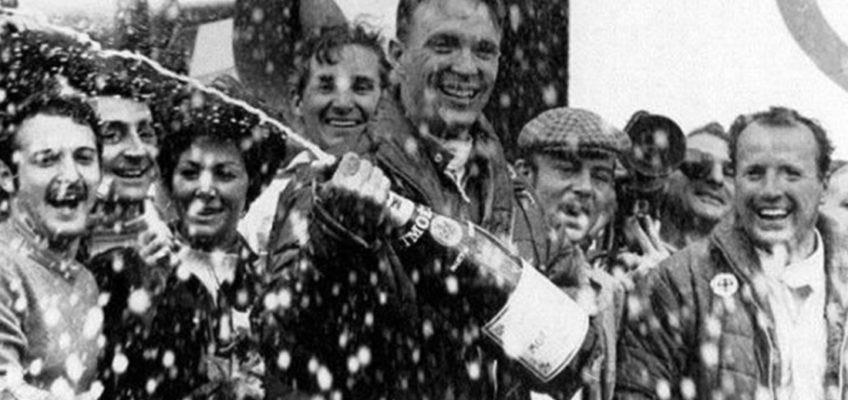
The first time was Le Mans, 1967. Le Mans is a 24-hour endurance race in France, the most punishing and prestigious event in motorsport, and in 1967 an American driver named Dan Gurney won it alongside A.J. Foyt in a Ford GT40. The victory was a big deal: Ford had been trying and failing to beat Ferrari at Le Mans for years, and this was the year they finally pulled it off. On the podium, a representative from Moet and Chandon handed Gurney a magnum.
What happened next depended on who you asked, but Gurney’s own account was fairly direct: “I shook it and sprayed everybody.” Drivers, photographers, executives, Henry Ford II, Carroll Shelby, their wives. Everybody got soaked. The photograph of that moment, Gurney grinning and shaking a magnum while the crowd flinched, became one of the defining images of motorsport. More importantly, it became a template for a certain kind of masculine performance. Within a decade it had spread to Formula One, then baseball, hockey, the NBA, until it was no longer an improvisation but an expectation, a ritual so deeply embedded in the culture of victory that not doing it would seem stranger than doing it.
Dan Gurney solved a problem nobody had yet articulated: victory is boring to watch. A man standing on a podium holding a trophy is a photograph. A man shaking a bottle of champagne and spraying it into a crowd is a moment. The champagne transformed celebration from documentation into spectacle, and spectacle is what television needs. Victory is internal, private, invisible. The champagne spray is the moment it becomes externalized. It is the climax the broadcast has been building toward for three hours: the explosive release that makes winning legible to the cameras. In other words, it is the money shot. Champagne here was no longer a beverage, nor even a symbolic talisman of victory. It was now a special effect that could render legible the feeling of having won.
Thorstein Veblen published “The Theory of the Leisure Class” in 1899, and I find myself returning to his ideas a lot when I think about the absurd ways people signal wealth and prestige. Most people know Veblen for the phrase “conspicuous consumption,” the idea that we buy expensive things largely to demonstrate that we can afford them. But Veblen made a much cooler observation that gets less attention. He distinguished between conspicuous consumption, which is about owning, and conspicuous waste, which is about destroying. He was writing about Gilded Age robber barons, but he might as well have been annotating a Migos verse. “I can afford to waste this” is the subtext of every champagne spray, every tipped-over bottle of Ace of Spades, every music video where the pool is filled with something drinkable. This is what we know, in common parlance, as stunting.
Anthropologists observed a version of this logic long before Veblen gave it a name. Among the Indigenous peoples of the Pacific Northwest Coast, the Haida, Tlingit, Kwakwaka’wakw, and others, the potlatch functioned as a ceremonial feast in which hosts gave away or destroyed valuable goods to demonstrate their wealth and power. Blankets, canoes, copper shields, food in staggering quantities: all distributed to guests or, in some cases, broken and cast into the fire. Early European observers found the practice baffling and, in a move that tells you more about European capitalism than about the potlatch, the Canadian government banned it in 1885. Why would anyone deliberately part with wealth? From the perspective of accumulation, the question made sense. From the perspective of prestige, it missed the point entirely. Status in a potlatch economy was not measured by what you kept but by what you could afford to give away or destroy. The more you wasted, the more power you demonstrated.
I do not want to draw too clean a line between the potlatch and the NBA locker room. One is a sacred institution practiced for centuries, the other a twenty-minute frenzy of corporate-sponsored champagne spraying. But the images are the same, and they show up everywhere once you start looking: Mark Cuban and his ninety-thousand-dollar Nebuchadnezzar of Ace of Spades, the old rap trope of pouring expensive liquor onto the ground as an offering to the fallen, bottle service sparklers and the procession of cocktail waitresses, skiers at Aspen’s Cloud Nine spraying Veuve Clicquot across the dining room in celebration of…we’re not sure what, exactly. Different cultures, different contexts, identical grammar. The object acquires meaning precisely when it ceases to exist as an object.
The NBA’s version of this ritual has been thoroughly professionalized. Today, what looks like chaos on television is an extraordinarily sophisticated operation. The league employs a “championship champagne squad,” a small army of staffers who transform a functional locker room into a waterproof celebration venue within minutes of the final buzzer. Plastic tarps go up over the lockers and cases of Moet are staged in advance. The bottles themselves have become increasingly theatrical, their sizing conventions borrowing from biblical nomenclature: Magnum, Jeroboam, Methuselah, Nebuchadnezzar. (Champagne may be the only consumer category to adopt sizing conventions named after Old Testament villains.) A standard bottle holds 750 milliliters. A Nebuchadnezzar holds fifteen liters, the equivalent of twenty standard bottles, and costs as much as a luxury sedan. It is already performing heavy symbolic duty before anyone opens it.
Cleanup crews stand ready. The room becomes what Howard Beck, writing for GQ, called “organized chaos,” though the emphasis is squarely on the first word.
In the modern era, goggles are basically mandatory. Champagne bottles are pressurized to roughly ninety PSI, and corks can become projectiles traveling at up to fifty miles per hour. The alcohol and acidity can cause corneal abrasions, which sting and blur vision for days. Ray Allen is credited with bringing the ski goggle trend to the NBA during the 2013 Heat championship, sporting a customized pair of white, red, and gold Oakleys, but baseball players had been experimenting with swimming goggles since the 1980s. The look has since become so entrenched that ESPN collaborated with the league in 2022 to design custom gold-trimmed “Victory Goggles” featuring the NBA’s 75th-anniversary logo. A ritual of Dionysian excess now requires its own branded personal protective eyewear.
The anxiety that attends these preparations is well-documented. Beck’s GQ piece describes the Nuggets equipment manager, a man named Sparky Gonzales, hurriedly wheeling fifteen pairs of goggles away from the locker room counter in the fourth quarter of Game 5 because the Heat had just taken the lead. There is no greater nightmare for the championship squad than a dejected team walking into a room already tarped and stocked with champagne. The league orders commemorative T-shirts and hats for both teams in every Finals, just in case. In a Game 7, workers might not know which locker room to prep until moments before the final buzzer.
The sponsorship architecture is almost as elaborate as the tarping logistics. Moet and Chandon, owned by LVMH, is the official champagne partner of the NBA and provides a dozen magnum-sized bottles of their Brut Imperial, NBA Edition. But the league’s contract does not actually require teams to spray Moet. Players and owners are free to bring in outside brands: Armand de Brignac, Veuve Clicquot, Dom Pérignon, whatever personal liquor label a player happens to be promoting. Michelob Ultra, by contrast, is the exclusive beer sponsor, and the only brand permitted to have visible logos, signage, and branded display bottles in the locker room. If players drink generic beers, the labels must be hidden or defaced. The room is divided by rigid corporate guidelines, every visible surface a negotiation between sponsorship dollars and genuine celebration.
Once you understand how the trick works, the magic should disappear, but the charade persists, and it seems to get more elaborate as time passes. We know where the ritual came from. We know the room has been tarped in advance. We know the goggles are waiting in a box beneath the arena. And still, when the first cork pops, none of it seems to matter. The machinery is visible and the feeling arrives anyway.
The reason, I think, is that the waste is not a byproduct of the celebration. It is the celebration’s entire mechanism. Victory is internal and invisible until someone makes it external and visible, and the champagne spray is the most efficient technology anyone has invented for doing that. You cannot photograph a feeling. You can photograph a Jeroboam of Moet arcing across a locker room in a thick white stream and hitting a man in the face. The destruction is what makes the image legible. The image is what makes the victory real. And the spectacular gayness of that imagery — well, that’s just an added bonus.
This is a strange inversion of what prestige Champagne is supposed to be for. The great houses spent more than a century constructing an association with refined consumption: the flute, the toast, the discreet sip. Sports culture looked at all that accumulated symbolic capital and saw a different product entirely. A delivery system for the kind of male ecstasy that has almost no other sanctioned outlet in American life. What makes Moet worth spraying is that it is expensive enough to be worth wasting. If it were cheap, the image would not work. If it were sipped rather than sprayed, the image would not exist. The ritual converts a luxury good into visual testimony that something extraordinary has occurred. You can fake a lot of things on television. You cannot fake the act of destroying something valuable.
Likewise, this visual economy wouldn’t work the same if the wines used were any good. Moet, Veuve, Armand de Brignac: these are prestige brands, but they are not great wines. Their value is constructed, and the construction depends partly on rituals like this one — on being seen wasted by champions, on becoming synonymous with victory long before most people ever taste them. The average drinker is more familiar with these bottles as special effects than as flavor experiences, which is precisely what makes them right for the job. Nobody is spraying magnums of Selosse or Marc Hébrart Special Club in an NBA locker room. These wines are too good to waste, and wasting them wouldn’t signal anything to people who don’t know what they’re looking at.
The ritual requires a wine whose value is legible to people who already understand wine in purely symbolic terms.