
Thirst Behavior is a project about wine, taste, and the social performances that form around them, the rituals of enjoyment shaped by status, media, money, and desire. Wine is the entry point; the real subject is how taste gets made, circulated, and contested, especially in New York and the Hamptons, where leisure and tastemaking overlap most visibly.
You can find my most recent feature here.
Friday features are always free, but if you want the weekly intel and ongoing education—plus to support independent wine writing that doesn’t do scores or sponsors—upgrade whenever it feels right.
If you’d like to work together or have consulting inquiries, pitches, or scoops, please email me at bodhilanda@gmail.com.
There is, at Vato, a kind of burrito that makes you realize how long you have been eating the wrong ones.
Not bad ones, necessarily, but wrong in the sense that, while technically satisfying, they still miss the point. The burritos at Vato are not especially large. They are not engineered to impress you with their weight or their tensile strength. They arrive slightly open at the ends, as if unwilling to fully seal themselves off, and they are built on flour tortillas that are so soft and warm they feel like an event in themselves—the reason the burrito exists.
The room is clean, breezy, and friendly. There are pastries—beautiful, almost distractingly so—that suggest a parallel universe in which you might abandon the burrito entirely and devote yourself to laminated dough. But the burritos hold. They insist.
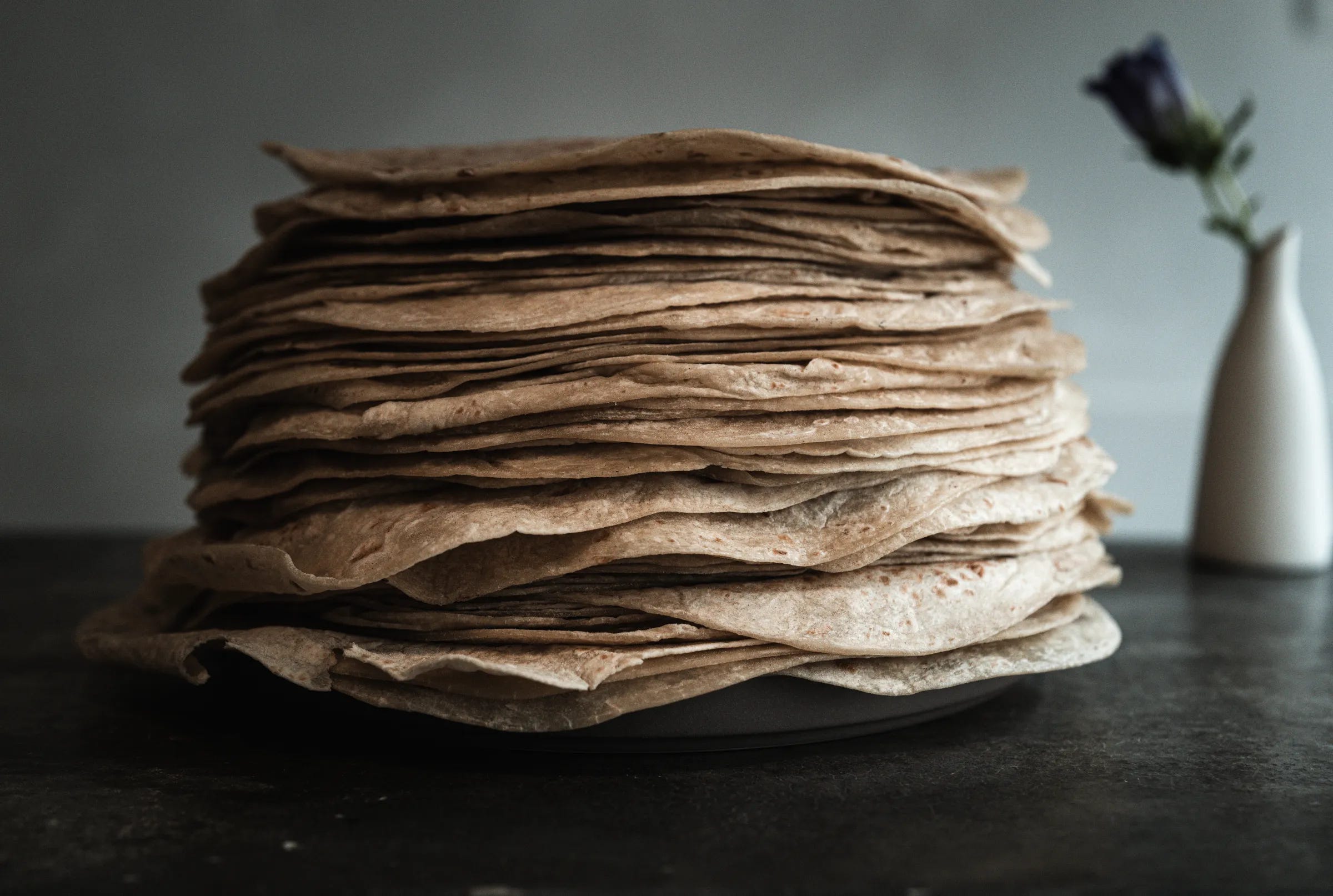
Vato is the casual, daytime offshoot of Corima, the Michelin-starred restaurant from chef Fidel Caballero, where the flour tortillas—sourdough-leaning, faintly tangy, unusually supple—have already achieved cult status. Here, in Park Slope, those tortillas are given a different role: not as an accompaniment, but as the organizing principle of a small menu of burritos, each composed in advance, each built around just a few elements. Vato operates, during the day, as a kind of tortilleria-bakery hybrid, counter service, pastries up front, burritos emerging from a separate station in the back, with a short list that tends to hover around a handful of options—pollo en mole, a verde with braised pork, a breakfast burrito with smoky burnt ends and eggs, and incredibly, the simple bean and cheese—variations that draw from the Northern Mexican culinary idiom of Chihuahua.
To call these burritos humble would be underselling them, but they are not spectacular either. They’re just honest and confident.
For years, the burrito here has functioned primarily as a delivery system: a loosely Mexican-adjacent cylinder designed to accommodate maximal input—rice, beans, protein, salsa, dairy, different beans, hotter salsa, a last-minute reconsideration. You do not order a burrito so much as assemble one, moving down a line and making a series of small declarations about yourself.
This is the enduring legacy of Chipotle Mexican Grill, which did not invent the burrito so much as reorganize it around the logic of choice. The early restaurants, modeled loosely on San Francisco’s Mission-style burritos, translated a regional, already hybridized form into a national interface. The burrito became a platform: adjustable, legible, and—crucially—yours.
But in reorganizing the burrito around preference, something has been lost. The burrito stopped arriving as a finished thought and began presenting itself as a personality test. It became less a dish than a process—one that mirrors the broader conditions of contemporary eating, where food is expected to accommodate the eater completely: optimized, modular, frictionless, and increasingly detached from any particular place or logic beyond your own.
I mostly grew up in Texas, where burritos were not a subject of debate or identity but simply a fact of the menu. The flour tortilla was standard and abundant—freshly made and stacked high in any H-E-B—and deeply pleasurable: soft, sometimes faintly elastic, occasionally carrying a fine dust of flour that would linger on your hands for hours if you didn’t bother to wash it off. The smell of it—warm, faintly fatty, almost sweet—was the smell of eating without thinking too hard about it.
In Colorado, where I also spent time as a child, the burrito took on a slightly different accent. There were often green hatch chiles involved, and a willingness, at times, to deep-fry the whole enterprise into a chimichanga, which felt like an unhinged regional flourish, though dazzling at times. Covered in a warm, tangy green sauce, this would be fully a fork-and-knife affair. These were not small burritos, nor were they austere, but they retained a sense of themselves as complete objects.
Even the more exuberant expressions of Mexican American vernacular cuisine—the Southern California variants stuffed with french fries, for instance, which have their militant devotees—operate within this same logic. The addition of fries is not an invitation to endless modification; it is a declaration. A regional habit. A point of view. If anything, it reinforces the idea that burritos, like wines, have terroir: not in the soil-bound sense, but in the looser, more human one—the accumulation of local preferences, histories, and available materials that give a thing its shape before you ever encounter it.
You are not meant to redesign it. You are meant to meet it where it is.
I did not fully understand this until a night in Los Angeles, under conditions that were, in retrospect, almost too perfect.
I had been on an elimination diet—no grains, no sugar, no dairy, no pleasures to speak of—and had failed, on that particular day, to plan what I was eating in accordance with my insane dietary protocol. By eleven o’clock, driving back toward a rented apartment in Boyle Heights, the situation had become untenable. I had not eaten all day and the city was closing around me.
So I swerved my rental car into the parking lot of a church, where there was a burrito stand. Tents, folding tables, and propane burners were set up with the ad hoc expertise of a longtime family operation. There was no branding, not even signage. But the regular trickle of neighborhood customers, even at this hour, was evidence enough that this place knew what it was doing.
I ordered one with everything, both salsas, to go. Whole30 be damned.
I remember standing there for a moment longer than necessary, watching them wrap it—foil pulled tight, a practiced fold at the base, the whole thing handed over unceremoniously, as if they’d done this a thousand times already that day.
Back at the apartment, I unwrapped it and encountered, on paper, nothing especially remarkable: rice, pinto beans, finely chopped carne asada, bright with lime, threaded with cilantro. The usual assemblage. Even to name the ingredients of this burrito misses the point. Because what those ingredients were doing together—held in tension, wrapped tightly in an impossibly elastic twelve-inch tortilla—was, in all seriousness, the most spiritually complete meal I have ever had. Everything was in proportion. Nothing dominated. Each element seemed less like a choice than like a necessity.
Hunger, certainly, sharpened the experience, but hunger did not invent it. The force of it came from somewhere else—from the fact that the burrito did not depend on me to complete it. It had already decided what it was. I had not designed it. I had submitted to it.
This is what I recognized again, years later in Park Slope.
At Vato, the burrito reasserts itself as something like a closed system, though, ironically, the ends themselves are not sealed. You can choose among a small number of variations, but the terms are set in advance. The proportions are considered. You are not asked what you want. You are asked which version of the idea you’re willing to accept. The tortilla—the actual, physical medium through which all of this is experienced—is treated not as a neutral container but as the defining element.
It is tempting to describe this as a return to authenticity, but that word is both overused and insufficient. Vato is not a time machine. It is a stylish, well-lit Brooklyn establishment with excellent pastries and a line out the door. It is, inevitably, part of the same culture that made its correction necessary. And yet the correction is real.
What feels new about these burritos is, paradoxically, their refusal to be new. They do not innovate so much as insist. To walk up to a space like this and order a straight up, honest-to-god, bean and cheese burrito from a Mexican dude with a mustache, decked in tasteful streetwear and plugs in his ears, felt like an emotional return to a version of home that was never quite this curated.
I still think about that burrito in Los Angeles, though I would be hard-pressed to find it again. It exists, for me, as a moment in which appetite, circumstance, and form aligned to give this otherwise ordinary experience the status of mythic exceptionality.
The burritos at Vato do not require quite so much deprivation. You can eat them in broad daylight. They do not overfeed you (one and a half is good for lunch unless pastries are involved, in which case you’re on your own). And you can take a leisurely stroll around the neighborhood afterwards without needing a nap.
But they gesture toward the same idea, which is easy to miss: that not every good thing improves under your supervision.