
Bistrot Ha
One of downtown’s most celebrated new restaurants succeeds by letting enthusiasm remain visible
Thirst Behavior is a project about wine, taste, and the social performances that form around them, the rituals of enjoyment shaped by status, media, money, and desire. Wine is the entry point; the real subject is how taste gets made, circulated, and contested, especially in New York and the Hamptons, where leisure and tastemaking overlap most visibly.
You can find my most recent feature here.
This piece is part of the Reviews section, where I visit restaurants, bars, and drinking establishments and look closely at the cooking, hospitality, and cultural theater of going out.
Reviews, like Friday features, are always free. But if you want the weekly intel and ongoing education—plus to support independent wine writing that doesn’t do scores or sponsors—upgrade whenever it feels right.
If you’d like to work together or have consulting inquiries, pitches, or scoops, please email me at bodhilanda@gmail.com.
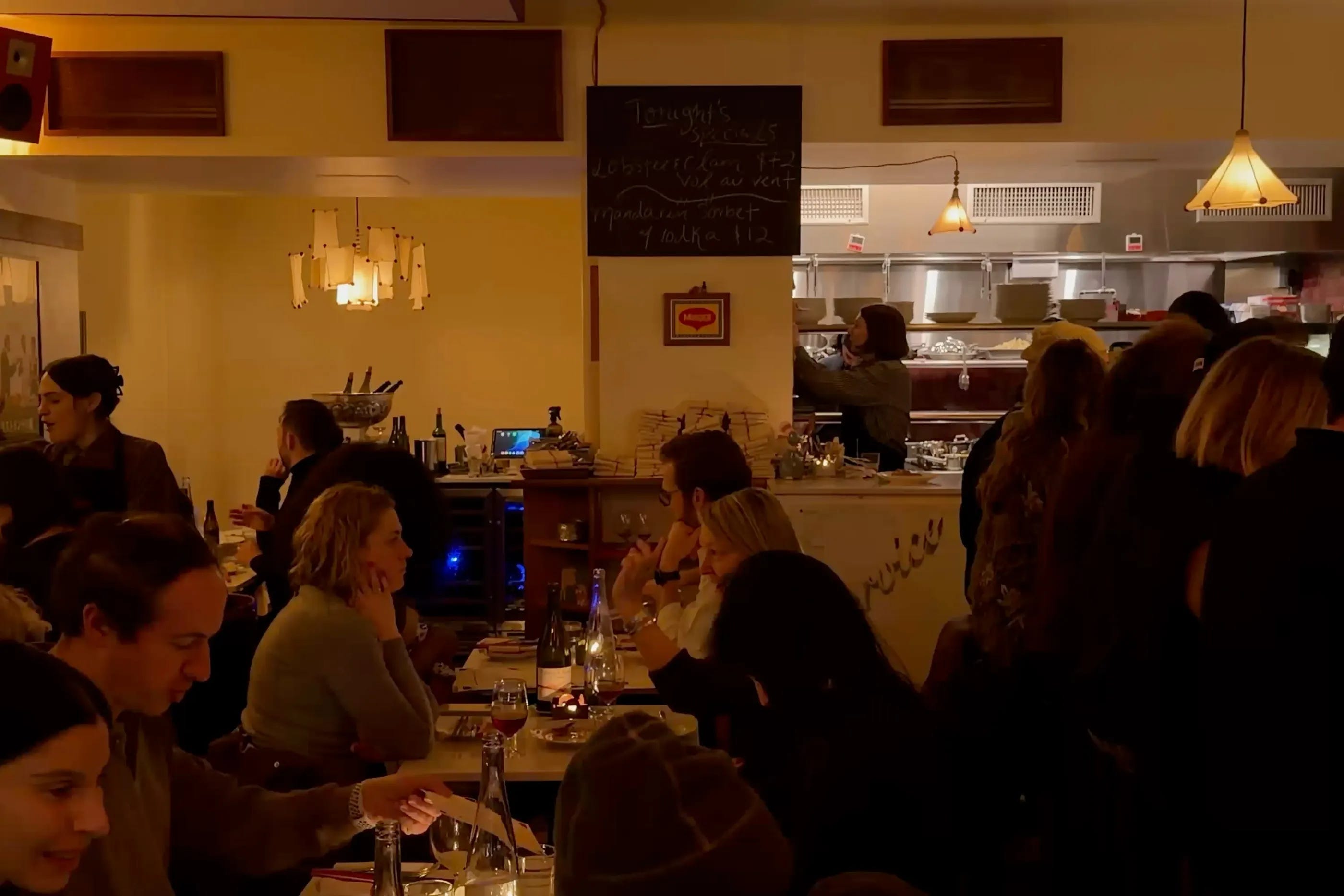
Bistrot Ha is loud. The music pushes right up against the volume of the crowd, and the crowd pushes right back. This place sustains a kind of perfectly managed overflow, a surplus of energy that makes you immediately want to order another drink.
The room is physically small — larger than the cultishly tiny Ha’s Đặc Biệt, the Lower East Side restaurant from owners Sadie Mae Burns and Anthony Ha that already achieved the status of downtown crown jewel — but it still operates with the compressed intensity of a place on the verge of combustion.
We sat three across at the corner of the bar, which to my mind is almost always the best seat in the house. From there you can watch the entire living organism function: Anthony Ha’s kitchen, staffed by only a handful of people, pushing out Viet/French bistro mutations with alarming efficiency while the dining room folds in around itself like an accordion. Nobody appears stressed exactly, but everyone seems locked into the same frenetic rhythm. The energy is less fine dining precision than extremely competent band practice.
The crowd, on the night I was there, skewed heavily toward the kind of people who still know how to have fun in restaurants without making a full content strategy out of it. Fashion people, wine people, hospitality people, a table of New York Times writers tucked into the back, downtown couples sharing cigarettes outside between courses. The room possessed the loose confidence of a place already canonized within the cultural class, but not yet flattened into a mandatory stop for finance guys who get their restaurant recommendations from TikTok. Bistrot Ha has already become one of the most critically successful openings in the city, but somehow still feels more beloved than contrived.
Part of that feeling comes from the fact that the restaurant allows enthusiasm to remain visible. Before we were seated, the host greeted us with a splash of German pét-nat. When I asked what it was, he admitted, smiling, that he wasn’t entirely sure how to pronounce the grape — “sch…something.” “Scheurebe!” I replied, perhaps too eagerly. For those who do not spend their free time thinking about obscure aromatic German varieties, Scheurebe makes highly perfumed wines full of grapefruit, herbs, tropical fruit and electric acidity; the sort of wine natural wine bars love because it feels simultaneously nerdy, unserious, drinkable and usually affordable. We exchanged a few quick thoughts about it before he had to greet the next arrival. The moment lasted only a few seconds, but it clarified something important about the restaurant’s overall proposition. At Bistrot Ha, hospitality arrives slightly ahead of mastery. The wine list is clearly assembled by people with serious taste, but what’s more immediately apparent is that everyone here seems genuinely psyched on what they’re serving.
That same improvisational swagger carries into the food. Nothing here tastes remotely dialed down. Contemporary downtown restaurant cooking has spent the last decade flirting with restraint, elegance, tiny portions arranged with architectural severity. Bistrot Ha appears to have looked at all this, shrugged, and decided that if a little fish sauce is good then an irresponsible amount might be even better.
The bartender, a tall and permanently cheerful presence working the corner closest to the door, joked while walking us through the cocktails that every dish on the menu contains fish sauce in some form, so they felt obligated to sneak it into a drink as well. The Ha’s Martini — gin, impossibly cold, garnished with a small pickled oyster — initially drinks cleaner than expected, almost delicate, until the oyster arrives afterward carrying a dense saline minerality that rephrases the cocktail retroactively. It eschews the muddy oxidized flavors of olive-brine that overtake many dirty martinis in favor of something sharper, colder, more tidal.
The menu itself plays a game of semantic camouflage. Dishes are described through ingredient fragments rather than recognizable forms, so that flavors arrive first as surprise and only later as recognition. A plate of asparagus appeared over a surprisingly bright, chopped egg sauce that, at first bite, revealed itself as a quirked-up take on gribiche; bright enough with vinegar to make the whole plate hum electrically. Smoky, pickled mussels scattered over the top kept interrupting the richness in brief jolts of marine funk. The bartender mentioned that the dish had only recently replaced the restaurant’s oft-lauded vertically arranged leeks vinaigrette, a reminder that the menu is in constant evolution.
Fried yuba stuffed with pork, shrimp, and cabbage arrived under the vague disguise of a tofu dish, only to immediately trigger the deep sensory memory of an exceptionally elegant Vietnamese egg roll. The yuba shattered with unbelievable crispness before collapsing into sweet-savory nuoc mam. Elsewhere, fried shrimp arrived beneath a glossy brown sauce whose acid and umami levels appeared calibrated by someone fundamentally unconcerned with moderation. At a certain point it becomes clear that the governing principle of the kitchen is not balance in the classical sense, but escalation. Every flavor, texture, and sensation is nudged just slightly beyond where another restaurant might stop. These dishes are cranked to eleven.
Usually this works beautifully. A peppercorn-crusted pork chop soaking in clam liquor and shrimp paste was probably the strongest dish we ate all night, managing to feel both bistro-ish and slightly deranged. A steak au poivre, meanwhile, arrived under a dense Sichuan-peppercorn-flecked sauce somewhere between the French pepper cream promised on the menu and Chinese-American brown sauce of childhood memory. Here, the kitchen’s tendency toward escalation briefly outran itself; the steak’s brazen savoriness exhausted the palate after a few bites. This particular dish was operating at, maybe, a twelve or thirteen. But strangely, even this felt consistent with the restaurant’s modus operandi. It is pursuing appetite at full blast.
I recognized the wine guy from his old job at Frenchette. He opened us a bottle of Ferme de la Sansonnière “La Lune,” a VdF of Chenin Blanc. In another context, a wine like this — oxidative edges, orchard fruit, wax, acidity held in tension with texture — might command the full intellectual attention of the table. Here it moved through the meal, cooling and resetting the palate against the relentless saturation of fish sauce, vinegar, shellfish and spice. Restaurants like Bistrot Ha, Win Son, and Sunn’s are helping normalize a style of pairing that still seems insane from the perspective of traditional wine culture: natural wines slammed against aggressively savory East and Southeast Asian flavor structures. But the pairing works because both the food and the wine prioritize energy over polish.
Sadie Mae Burns, who remained in constant motion throughout the evening running food, clearing tables, and working the room, stopped by at one point to say hello and make sure we were taken care of. What struck me was not simply her competence, though there was plenty of that, but the sheer amount of warmth she still seemed capable of generating outward into the room despite the velocity of service around her. Some people possess a genuine gift for making strangers feel welcomed into the momentum of an evening, and Sadie seems to operate almost entirely on that frequency.
By that point the room had entered the wavy part of the evening where everyone seems to be pleasantly absorbed in the charming excesses of dining out. More bottles arriving. More fries than the table could possibly need. The music somehow just a little louder than before. The strange achievement of Bistrot Ha is that it manages to sustain all this energy without making too big a show of it. The place still feels genuinely thrilled to exist. It has not yet sanded down its edges into the defense mechanism of fake refinement. It still feels in process, very confident, occasionally ridiculous, and very much convinced that dinner should be fun.
You leave slightly overfed, slightly overstimulated, and with a ringing in your ears — fully convinced to go out for one more martini.